U of C and MRU Student Commuter Rideshare Guide
TL;DR
- Audit your weekly U of C or MRU timetable by trip leg to spot where CTrain and MAX bus transfers slow down off-peak commutes.
- Pair your student UPass with shared rides from suburban Park-and-Ride hubs along Crowchild Trail, Stoney Trail, and Glenmore Trail.
- Split campus parking permits and weekly fuel fairly among two to four occupants under Alberta non-commercial cost-sharing rules.
- Confirm pickup landmarks via In-App Chat the evening before winter storms and add a 15-minute departure buffer for icy roads.
Share Your Daily Campus Commute on FellaRide
Connect with verified Hosts and Guests in campus Trusted Groups to split fuel and parking costs without platform commissions.
What you need
Getting across Calgary for morning lectures at the University of Calgary or late tutorials at Mount Royal University takes planning.
- A valid UPass: Included for eligible full-time students to ride Calgary Transit CTrain and MAX rapid bus routes when shared rides do not align with your hours.
- A verified FellaRide account: Available on iOS and Android to commuters aged 18 or older for joining a campus Trusted Group.
- A government-issued ID: Required if you complete identity and liveness verification through Persona to earn a profile verification badge.
- 15 minutes of planning time: Enough to map your primary highway corridors, Crowchild Trail pickup hubs, and parking lot options before classes start.
1. Audit Your Lecture Timetable and Calgary Campus Corridors
An 8:00 a.m. organic chemistry lecture in the Science Theatres at the University of Calgary looks very different on a map when you commute from Somerset in the deep south versus Panorama Hills in the north.
When your classes spread across different days, mapping both rail corridors and regional ring roads helps you spot where transfers slow you down. Look closely at how your home neighbourhood connects to Calgary's post-secondary arteries:
- Northwest Campus Corridor (U of C Main and Foothills): Linked directly by Crowchild Trail NW, 16 Avenue NW (Trans-Canada Highway), Shaganappi Trail, and the Red Line CTrain stops at University and Brentwood stations.
- Southwest Campus Corridor (Mount Royal University in Lincoln Park): Reached via Crowchild Trail SW, Glenmore Trail, Richard Road SW, and the MAX Yellow and MAX Teal bus rapid transit lines.
- Suburban Ring Road Connectors: Stoney Trail (Highway 201) and Deerfoot Trail (Highway 2) carry perimeter commuters from outlying quadrants into Glenmore Trail, 16 Avenue, or McKnight Boulevard.
Write down the door-to-door travel time for each leg, including the icy walk from the CTrain platform or outer surface parking lot to your classroom. Highlight the days where an evening lab or a split schedule forces you into multiple cold transfers across quadrants. You can follow a similar framework in our university commuter guide comparing transit and campus carpools.
2. Compare CTrain, MAX Bus Lines, and Student Carpooling to U of C and MRU
You do not have to choose exclusively between public transit and driving alone. Many university commuters build a hybrid routine that pairs Calgary Transit rapid routes with targeted cost-sharing rides on days when bus transfers bog down.
While the Red Line CTrain drops U of C students directly at University Station, reaching Mount Royal University in Lincoln Park requires boarding a bus connection such as the MAX Yellow from downtown or the MAX Teal from Westbrook and Heritage stations. For students living in outer communities like Cranston, Evanston, or Tuscany, the first-mile and last-mile gap often turns a twenty-minute highway drive into a seventy-minute transit journey.
- Suburban First-Mile Links to the CTrain: Match with a Host from your subdivision to a major hub like Tuscany, Brentwood, or Somerset-Bridlewood Station, skipping slow feeder bus loops.
- Direct Quadrant-to-Campus Carpools: Ride directly along Stoney Trail and Glenmore Trail into MRU's Lincoln Park campus without routing through downtown Calgary first.
- Morning Shared Ride, Evening Transit: Catch a morning shared ride to arrive warm for an early exam, then use your UPass on the CTrain or MAX bus home after late library sessions.
Read more in our breakdown of app-based carpooling pros and cons for commuters.
Sharing a ride bridges the gap between expensive solo campus parking and multi-transfer winter bus waits.
| Factor | CTrain & MAX Rapid Transit | Solo Campus Driving | Non-Commercial Carpooling |
|---|---|---|---|
| Crowchild Trail travel time | Fixed rail on NW Red Line; bus transfers to SW | Direct highway route; slows at bridge bottlenecks | Direct point-to-point route with shared pickup hub |
| Winter weather exposure | Exposed outdoor platform and bus stop waits | Warm cabin; solo scraping and snow clearing | Direct ride in a warm vehicle with peers |
| Last-mile link to Varsity or Lincoln Park | Direct to U of C; bus transfer required for MRU | Park directly in campus lots or parkades | Drop-off directly at shared campus parking lot |
| Semester cost predictability | Covered by semester UPass fee | Full cost of fuel, maintenance, and parking pass | Shared fuel and parking split agreed upfront |
3. Split U of Calgary Student Rideshare Parking and Fuel Under Alberta Rules
True peer-to-peer carpooling means a Host and one or more Guests share the genuine travel expenses of a trip the Host is already taking, without generating commercial profit. As outlined in our guide on how non-commercial carpooling works, a private vehicle used strictly for shared-expense commuting stays non-commercial when reimbursement covers only actual operating costs.
Sharing a ride with commuters heading the same way directly reduces personal fuel use and traffic congestion while cutting tailpipe emissions across busy city corridors. On FellaRide, the marketplace charges zero platform commissions and never uses surge pricing, so every dollar contributed goes toward dividing legitimate trip expenses.
Campus parking fees make up a major portion of a Calgary student's budget. Whether a Host parks at the University of Calgary's McMahon Stadium (Lot 10), outer surface lots like Lot 11 or Lot 32, the covered Arts Parkade, or Mount Royal University's East Gate Parkade, splitting that permit and weekly gas bill across two to four occupants drops individual expenses sharply:
- Recover actual expenses only: Divide fuel, campus parking permits or daily flat-rate lot fees, and reasonable vehicle wear without adding a markup.
- Keep your personal auto policy valid: Confirm with your insurer that your vehicle is rated for daily campus commuting rather than pleasure-only use, and carry only cost-sharing Guests.
- Agree on terms before departure: Use FellaRide's preset cost-sharing visibility and In-App Chat so nobody has to haggle over cash in the parking lot.
Tip: Confirm your exact pickup landmark and waiting window in In-App Chat the evening before a morning trip, especially ahead of winter snowfalls.
4. Join Verified Campus Trusted Groups and Match With Peers on FellaRide
Finding reliable classmates who share both your quadrant and your lecture blocks is much simpler inside a closed community than on an anonymous classified page. Posting on unverified social media boards carries risks because you cannot confirm who is on the other side of the message.
On FellaRide, a Trusted Group is a private or semi-private community where participants share a campus, workplace, or neighbourhood bond. Matching with fellow post-secondary commuters gives everyone shared institutional context around midterms, campus drop-off zones, and student budgets. Learn more in our student carpooling guide for better campus commutes.
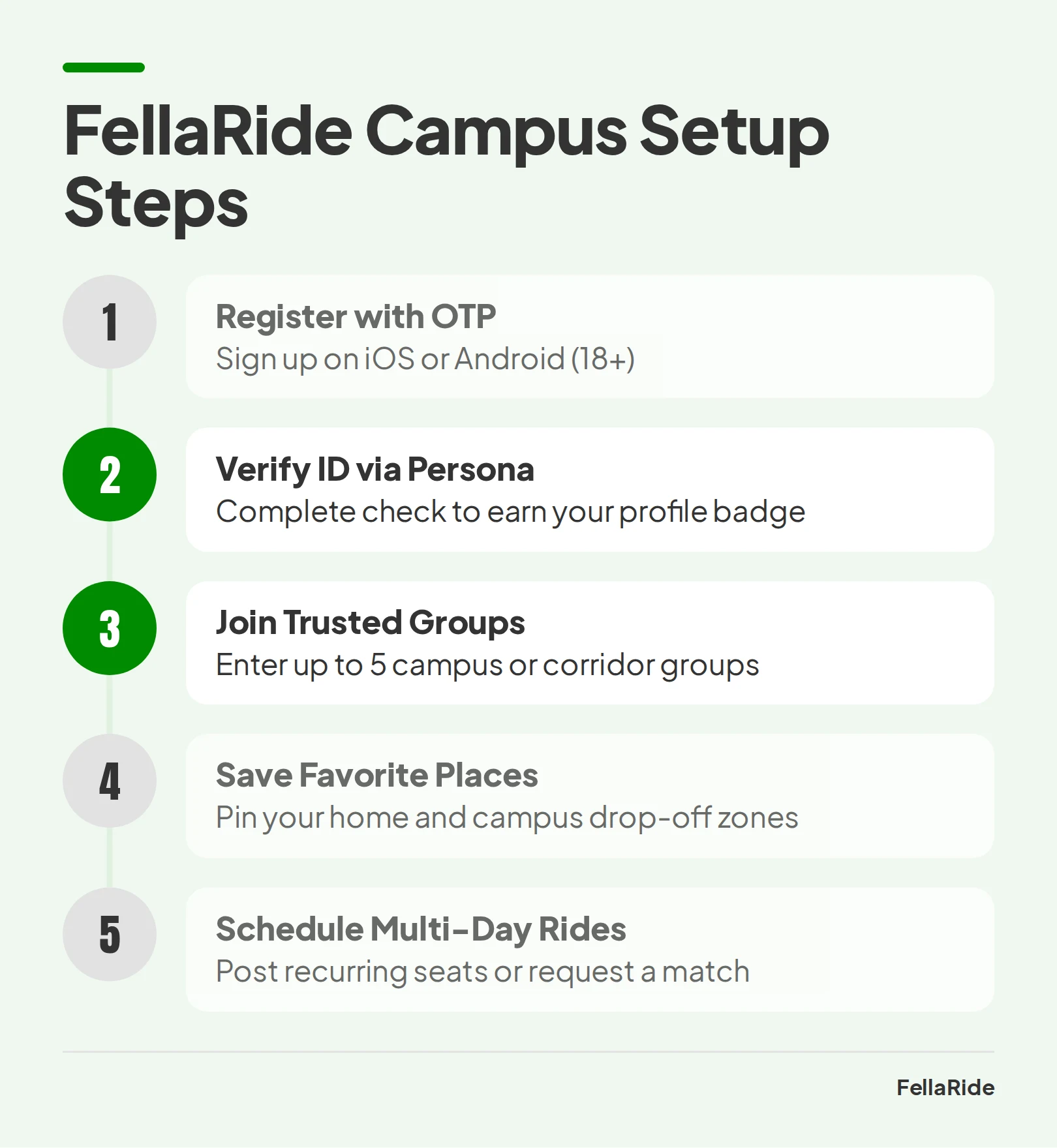
Work through this ordered setup routine to build your commuter profile and schedule recurring campus rides:
- Lock in recurring semester trips: Hosts can select Post a Ride with Multi-Day Scheduling to offer spare seats on recurring lecture days, while Guests can use Search a Ride or Post a Ride Request to find matching trips in their communities.
5. Set Pickup Hubs Along Crowchild Trail, Stoney Trail, and Park-and-Ride Lots
If your carpool group lives across different cul-de-sacs in the northwest or deep south, the Host does not need to weave through snow-rutted residential streets to pick everyone up at their front doors. Meeting at a central transit Park-and-Ride or highway interchange landmark keeps the Host's route direct and trims fifteen minutes off the morning drive.
Pairing major arterial hubs with FellaRide's Built-In Maps Navigation and Real-Time Ride Tracking lets Guests see exactly when the vehicle is approaching the designated pickup zone. Choose clear, well-lit meeting corners with easy right-turn merges onto your main corridor:
- Northwest Crowchild and Stoney Hubs: Tuscany Station drop-off loop for Guests, Crowfoot Station Park-and-Ride, Dalhousie Station, or Brentwood Station along Crowchild Trail NW.
- Southwest Glenmore and MRU Approaches: 69 Street SW Station along the West LRT, Westbrook Station off Bow Trail, or Heritage Station near Glenmore Trail and Macleod Trail.
- Campus Drop-Off Landmarks: U of C's MacEwan Student Centre loop, Lot 10 pedestrian overpass at McMahon Stadium, or MRU's East Gate Parkade turnaround on Richard Road SW.
Sitting in a warm vehicle for thirty minutes with three classmates from your quadrant also turns empty travel time into a supportive micro-community. Over a semester, sharing local tips on winter gear, course registration, and campus internships builds real friendships alongside fuel savings. Before your first morning meet-up, coordinate your group's pickup window and review our guide for international and commuter students.
6. Prepare Your Calgary Student Carpool for Sub-Zero Winter Driving and Chinooks
Calgary winters swing rapidly between deep sub-zero cold snaps and warm Chinook winds that melt roadside snowbanks during the afternoon lecture block, only for that meltwater to refreeze into black ice on the Crowchild Trail Bow River bridge by nightfall. Waiting twenty minutes outdoors at an exposed wind-swept bus stop drains your focus before class even starts.
Before snow squalls hit the foothills, Hosts should equip their vehicles with proper winter tires, store an emergency roadside bin in the trunk, and check highway conditions with their Guests before departing. Preparing both the vehicle and your group communication keeps your campus routine steady when heavy snow slows down Glenmore Trail or Stoney Trail.
Set aside one evening with your carpool partners to work through our full guide on preparing your carpool for winter weather and snowstorms and confirm these five readiness habits:
- Mount four matching winter tires: Check tread depth ahead of the first autumn snowfall so the Host's vehicle grips icy inclines along Home Road NW, Sarcee Trail, and Glenmore Trail.
- Stock a weatherproof trunk bin: Pack recovery tools, warm layers, and emergency supplies inside a secure storage bin that will not slide around.
- Top up cold-weather fluids and wipers: Fill the reservoir with sub-zero windshield washer fluid, install winter-grade wiper blades, and keep a long-reach snow brush with an ice scraper within arm's reach.
- Confirm pickups the evening before: Message your group in FellaRide's In-App Chat every night before a morning storm to lock in your arterial meeting corner and a 15-minute snow day departure buffer.
- Share live trip progress: Use Real-Time Ride Tracking during active snowfalls so Guests can wait inside a heated transit shelter or lobby until the Host approaches.
Build Your Recurring Campus Carpool Routine
Join up to 5 Trusted Groups, match along your corridor, and schedule one-time or recurring shared rides across the semester.
FAQ
Is student cost-sharing carpooling legal in Alberta without a commercial licence?
Yes, non-commercial carpooling is permitted in Alberta when a private Host shares a trip they are already taking and only recovers genuine travel expenses such as fuel, parking fees, and reasonable vehicle wear. FellaRide operates strictly as a non-commercial cost-sharing marketplace without platform commissions or surge pricing.
How does FellaRide verify post-secondary commuters before we share a ride?
Every FellaRide user must be at least 18 years old and confirm their phone number and email with a one-time passcode during registration. Commuters can then submit a government ID and selfie through Persona for identity and liveness verification to earn a profile badge, while FellaRide stores only the verification status and expiry dates rather than the ID documents.
What happens if my afternoon lab runs late and I miss my carpool Host?
You can board the Red Line CTrain from University Station or the MAX Yellow and MAX Teal rapid buses from Mount Royal University to get home at your own pace.
Can we schedule recurring carpools for Monday-Wednesday-Friday lecture blocks?
Yes, Hosts can use FellaRide's Multi-Day Scheduling and Post a Ride tools to publish recurring trip schedules that match their weekly lecture timetable. Guests looking for a steady seat along the same corridor can filter available trips with Search a Ride or publish their own schedule using Post a Ride Request inside their Trusted Group.
Sources
- How Non-Commercial Carpooling Works in Ontario
- Preparing Your GTA Carpool for Winter Weather & Snowstorms
Build Your Recurring Campus Carpool Routine
Join up to 5 Trusted Groups, match along your corridor, and schedule one-time or recurring shared rides across the semester.