GTA University Commuter Guide: Save Time & Money on Rides
What you need
Getting across the Greater Toronto Area for morning lectures and late labs takes planning. Before building your weekly travel routine, gather a few essentials so you can compare fares, travel times, and route matches accurately.
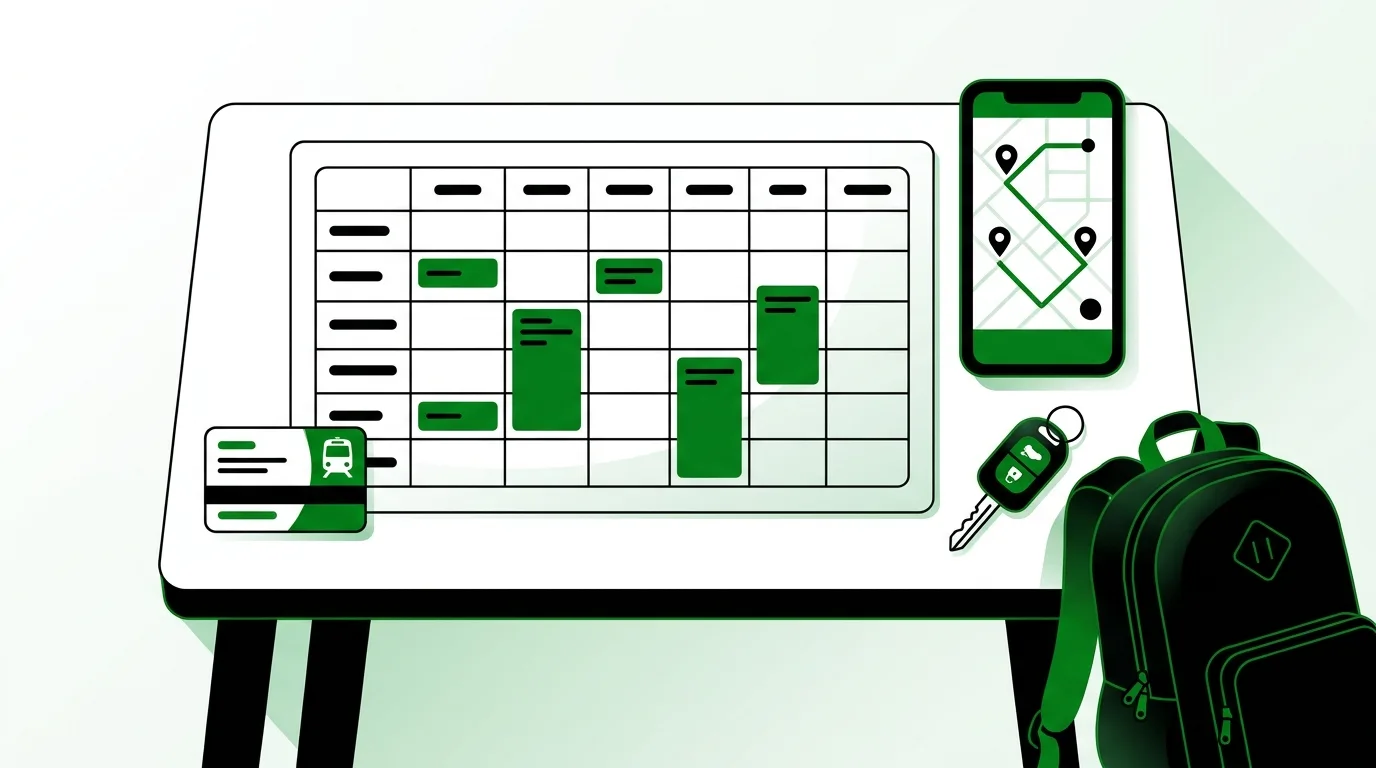
- Your finalized timetable: List exact start and end times for lectures, tutorials, and labs across all campuses.
- A PRESTO card: Useful for paying single transit fares, applying for a GO Transit post-secondary discount, or loading a TTC Post-Secondary Monthly Pass.
- A verified FellaRide account: Available to individuals aged 18 or older on iOS and Android for joining a campus Trusted Group.
- A government-issued ID: Needed if you choose to complete optional identity verification through Persona.
- 15 minutes of planning time: Enough to map your primary highway and transit corridors before classes begin.
1. Audit Your Weekly Lecture Schedule and GTA Commute Corridors
An 8:00 a.m. lecture at the University of Toronto's St. George campus looks very different on a map when you live in Brampton versus Scarborough. Start by breaking your week into individual trip legs rather than treating every weekday the same. Many post-secondary students commute at off-peak hours when suburban feeder buses run less frequently.
When classes spread across different days and times, mapping both rail corridors and regional highways helps you spot where transfers slow you down. Look at how your home connects to your specific campus across the GTA's main arteries:
- Downtown Toronto (U of T St. George, TMU): Served by the Lakeshore, Kitchener, and Barrie GO lines into Union Station, followed by TTC Line 1 subway transfers, or via the Gardiner Expressway and Don Valley Parkway.
- North York (York University Keele and Glendon): Linked by the Line 1 subway extension, Highway 407 regional buses, and Highway 400 and 401 corridors.
- Peel and Halton (Sheridan College, U of T Mississauga): Connected across Oakville (Trafalgar), Brampton (Davis), and Mississauga (Hazel McCallion) via the Queen Elizabeth Way, Highway 401, Highway 403, and Hurontario Street.
Write down the door-to-door time for each leg, including the walk from the subway station or campus parking lot to your lecture hall. Highlight the days where a late evening lab or midday break forces you into two-hour transit transfers across municipal boundaries.
2. Compare GO Transit, TTC, and Campus Carpooling for Your Route
Once you know your corridors, weigh the cost and time of regional transit, local subways, and private cost-sharing rides. Each mode suits a different kind of student schedule.
Regional and Local Public Transit
Full-time post-secondary students can apply for a student fare discount on GO Transit, while TTC riders can either pay standard adult single fares or buy a Post-Secondary Monthly Pass on a PRESTO card (which requires a TTC post-secondary photo ID). Furthermore, Ontario's One Fare Program lets riders pay only once when transferring between the TTC and participating GTA transit agencies like GO Transit, MiWay, Brampton Transit, York Region Transit, and Durham Region Transit.
A monthly TTC pass makes sense if you ride the subway or streetcar almost every day. However, if your classes are compressed into two or three days a week, paying per ride or sharing a carpool often costs less than a flat monthly pass.
Non-Commercial Campus Carpooling
FellaRide operates as a technology marketplace that connects individuals for non-commercial, cost-sharing carpooling rather than acting as a commercial carrier. Hosts are private individuals driving their own vehicles who share empty seats with Guests heading the same way, and profit is strictly prohibited.
To keep contributions fair and aligned with Canadian carpooling norms, you can review the platform terms and cost-sharing guidelines before booking. FellaRide recommends a minimum fare of $5 per ride (including stops and multi-leg trips) and a guideline rate of $0.20/km to help a Host recover shared travel expenses.
Additionally, Ontario's High Occupancy Vehicle (HOV) lane network on series 400 highways allows vehicles carrying at least two people to bypass single-occupant congestion. Sharing a ride along Highway 403, the QEW, or Highway 404 can shave significant time off a suburban-to-campus drive.
| Option | Cost Structure | Schedule & Route | Best Student Fit |
|---|---|---|---|
| GO Transit | Distance-based PRESTO fare | Fixed rail and bus corridors | Long-distance rail to Union or York |
| TTC | Single fare or monthly pass | High-frequency urban grid | Daily riders living within Toronto |
| FellaRide Carpool | $5 minimum and $0.20/km guideline | Custom Host and Guest pickup points | Cross-suburb trips and multi-day schedules |
3. Join Verified Campus Trusted Groups to Find Fellow Students
Carpooling works best when you travel with people who share your destination and daily context. Instead of searching an open public board, you can browse FellaRide's Trusted Groups across the GTA to connect with fellow students and staff.
A Trusted Group is a private or semi-private community built around a common bond such as a campus, workplace, or neighborhood. Existing communities across the GTA include groups for the University of Toronto, Sheridan College, and Downtown Toronto, helping commuters heading to nearby campuses like TMU or York University build familiarity over time.
Follow these steps to set up your profile and join your campus groups:
- Register your account: Install the mobile app on iOS or Android, provide your name, email address, and phone number, and confirm your account with a one-time passcode (OTP). Users must be at least 18 years old.
- Complete Persona identity verification: Submit a selfie and government ID through Persona, a third-party provider, for identity and liveness checks. FellaRide stores only your verification status and expiry dates rather than your ID documents, and awards a profile badge that increases trust.
- Select up to 5 communities: Because FellaRide limits each user to a maximum of 5 communities (and caps total membership per group to maintain quality), pick the groups that directly match your campus and home corridor.
- Update your account settings: Open Settings and select Account to add your emergency contact, preferences, and accurate vehicle details if you plan to act as a Host.
4. Set Up Recurring Rides and Flexible Requests Around Changing Class Times
University timetables rarely follow a 9-to-5 pattern. You might have fixed morning lectures on Tuesdays and Thursdays, a rotating biweekly science lab on Wednesdays, and study group sessions before midterms. Check the FellaRide in-app experience overview and the help and info guide to combine recurring schedules with one-time trips.
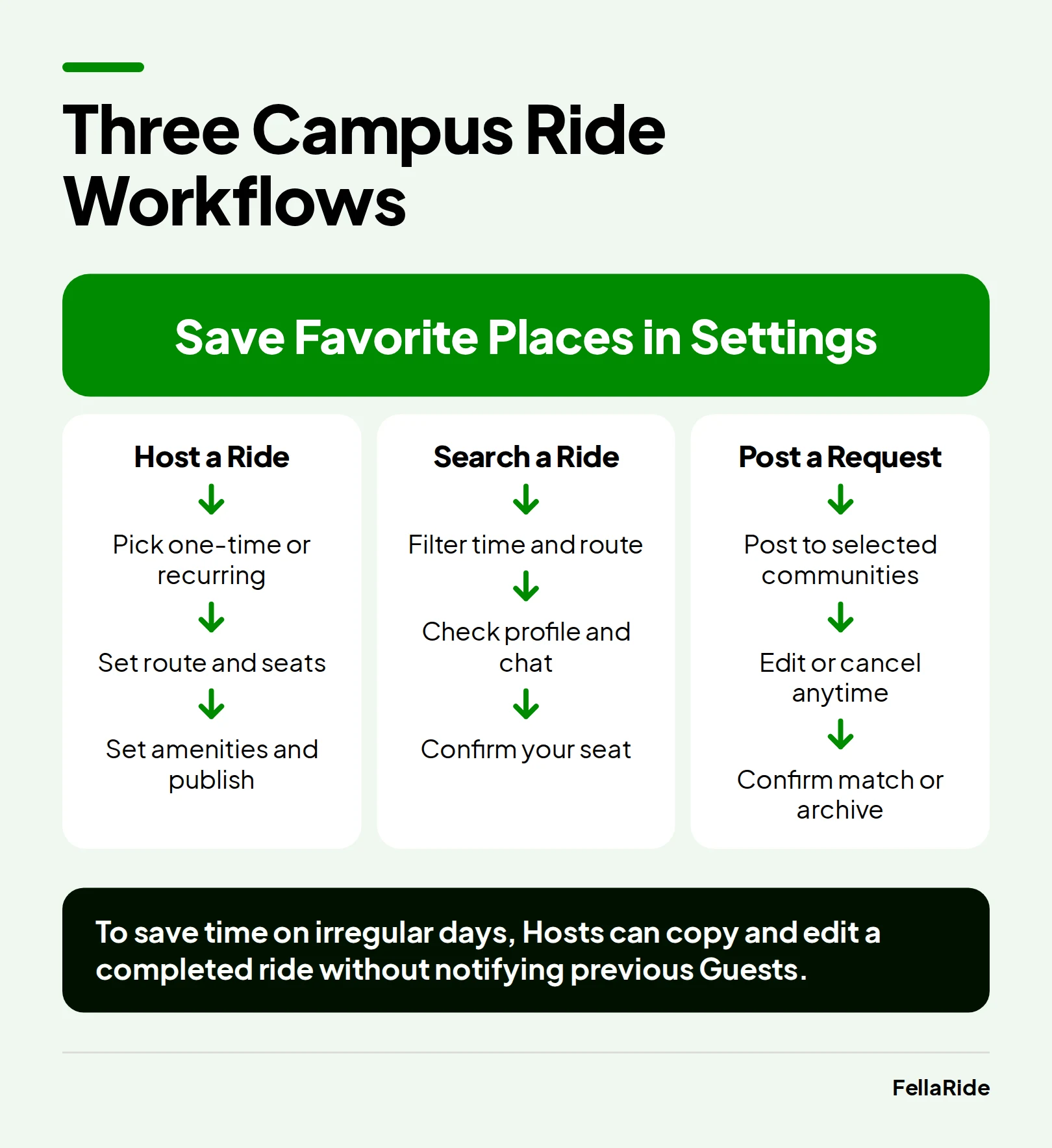
- Save your Favorite Places: Go to Settings and select Manage Saved Addresses to store private locations like your home, campus building, or a nearby GO station. Favorite Places remain private to you and make trip posting and searching much faster.
- Post a Ride as a Host: If you drive to campus, open Post a Ride and choose either a one-time trip or a recurring multi-day schedule. Set your route, intermediate stops, departure time, available seats, vehicle details, and ride preferences, then publish to your communities.
- Configure vehicle amenities each time: Note that vehicle preferences and amenities are not auto-enabled; Hosts must manually configure them before publishing each ride. To save time on irregular days, you can copy a completed ride, edit the details, and republish it without automatically notifying previous Guests.
- Search a Ride as a Guest: Open Search a Ride to filter listings by date, time, route, and community. Check Host profiles and use in-app chat to align on details before confirming your seat.
- Post a Ride Request when schedules shift: If no listing matches a late seminar or exam slot, post a ride request to your selected communities. Only members of those communities can view it, and you can edit or cancel the request anytime before it is confirmed.
Tip: Ride requests stay active until you cancel them, a matching ride is confirmed, or the ride date passes (at which point expired requests are automatically archived).
5. Coordinate Pickup Points, Safety Checks, and Cost Contributions
A smooth campus commute depends on clear communication and mutual accountability between the Host and every Guest. Before heading out, use the built-in maps and in-app chat to confirm your exact meeting spot, such as a designated Kiss and Ride drop-off loop outside a subway station or a specific campus parking lot.
Keep these safety, punctuality, and payment rules in mind for every trip:
- Be on time at the pickup point: Guests must arrive promptly; a Host may depart if a Guest is more than 5 minutes late. If your plans change, cancel promptly so others can adjust, as repeated cancellations can lead to account suspension.
- Verify insurance and licensing (Hosts): FellaRide does NOT provide insurance. Every Host must hold a valid Canadian driver's license, maintain legally required auto insurance, and confirm their insurer allows cost-sharing carpooling.
- Use Enroute live tracking: Location sharing operates only during Enroute rides and is visible solely to co-participants who also have location sharing enabled. Hosts must end the trip and turn off location sharing right after reaching the final drop-off point.
- Rate your ride: After completing the trip, leave a rating to build community reliability (ratings can be edited within a limited window after submission).
Watch out: Never share sensitive financial details such as banking information, payment card numbers, authentication credentials, or identity documents with other users, and keep all coordination inside the app's chat.
6. Combine Transit Passes and Shared Rides for Mid-Day Campus Transfers
You do not have to choose exclusively between public transit and carpooling. Many GTA students use a hybrid routine that pairs rapid rail or subway corridors with targeted cost-sharing rides on days when transfers bog down.
Consider these practical hybrid combinations for multi-campus or split-day schedules:
- Suburban Park-and-Ride to GO or Subway: Match with a Host from your neighborhood to a major hub like Highway 407 Station, Kipling Station, or Oakville GO, avoiding slow local feeder buses.
- Inter-Campus Midday Hops: Students splitting classes between U of T St. George and UTM, or moving between Sheridan's Trafalgar, Davis, and Hazel McCallion campuses, can coordinate direct highway carpools between lectures.
- Morning Carpool, Evening Transit (or Vice Versa): Catch a morning shared ride to arrive fresh for an early morning exam, then take the TTC or GO train home at your own pace after evening library sessions.
Because carpooling relies on a Host's personal schedule and ride availability is not guaranteed, keeping a loaded PRESTO card in your wallet gives you a reliable backup whenever lecture times change unexpectedly.