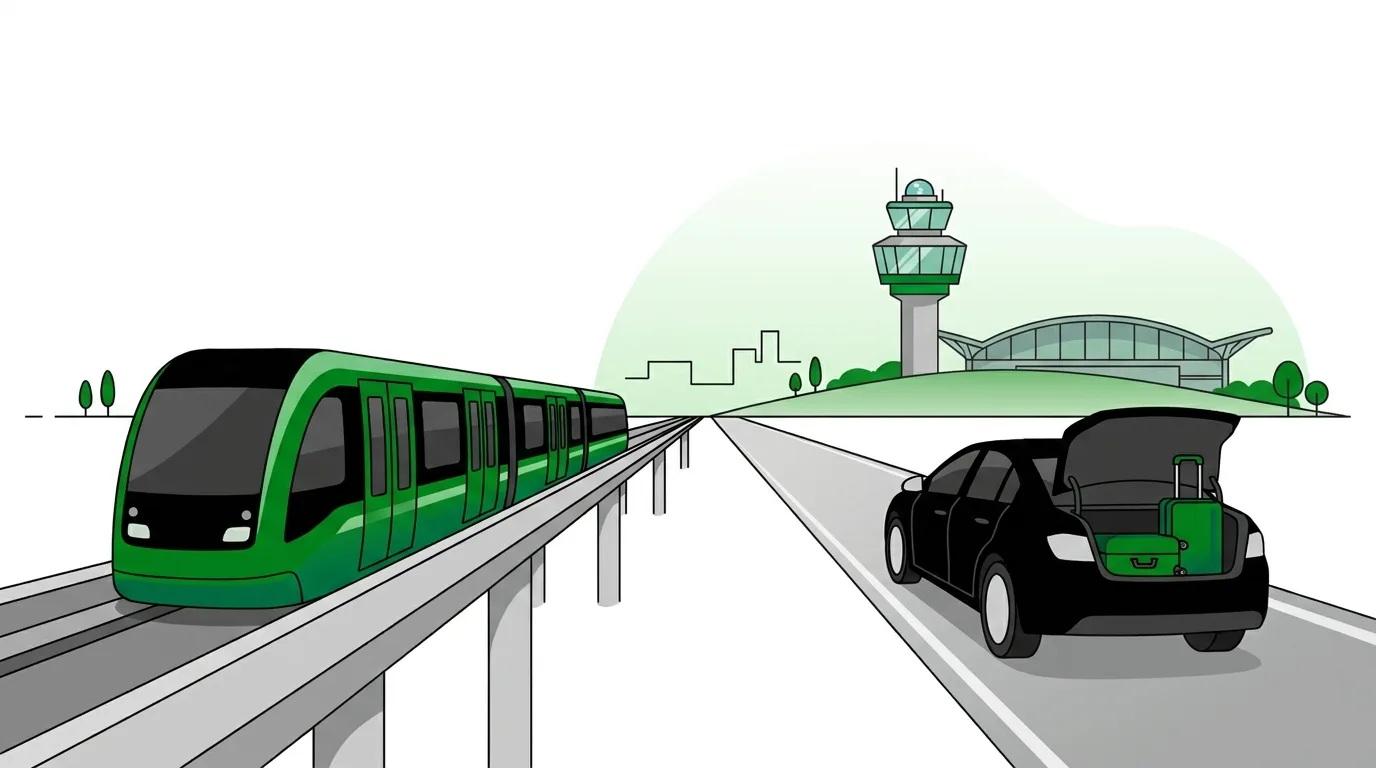
How Non-Commercial Carpooling Works in Ontario
TL;DR
- Non-commercial carpooling in Ontario lets you share a trip you are already taking as long as you only recover actual expenses.
- Drivers and passengers can legally split fuel, Highway 407 tolls, parking fees, and reasonable vehicle wear and tear without making a profit.
- Standard Ontario personal auto insurance policies cover non-commercial cost-sharing carpools when your vehicle is insured for commuting.
- Having at least two people in the vehicle unlocks provincial HOV lanes and free carpool parking lots across the Greater Toronto Area.
In this article
- What Makes a Carpool Non-Commercial Under Ontario's Carpooling Rules
- Legitimate Cost-Sharing: Splitting Gas, Tolls, and Parking Without Making a Profit
- How Auto Insurance and Liability Work When You Carpool in Ontario
- Using HOV Lanes and Carpool Parking Lots Across the Greater Toronto Area
- How Trusted Workplace, Campus, and Community Groups Simplify Daily Commutes
- Practical Safety and Etiquette Tips for Drivers and Passengers
- FAQ
- Sources
What Makes a Carpool Non-Commercial Under Ontario's Carpooling Rules
Every weekday morning across the Greater Toronto Area, thousands of drivers sit in Highway 401 traffic with empty passenger seats. Sharing those seats with coworkers or fellow students is a simple way to cut commuting expenses, provided you follow Ontario's legal definition of a carpool.
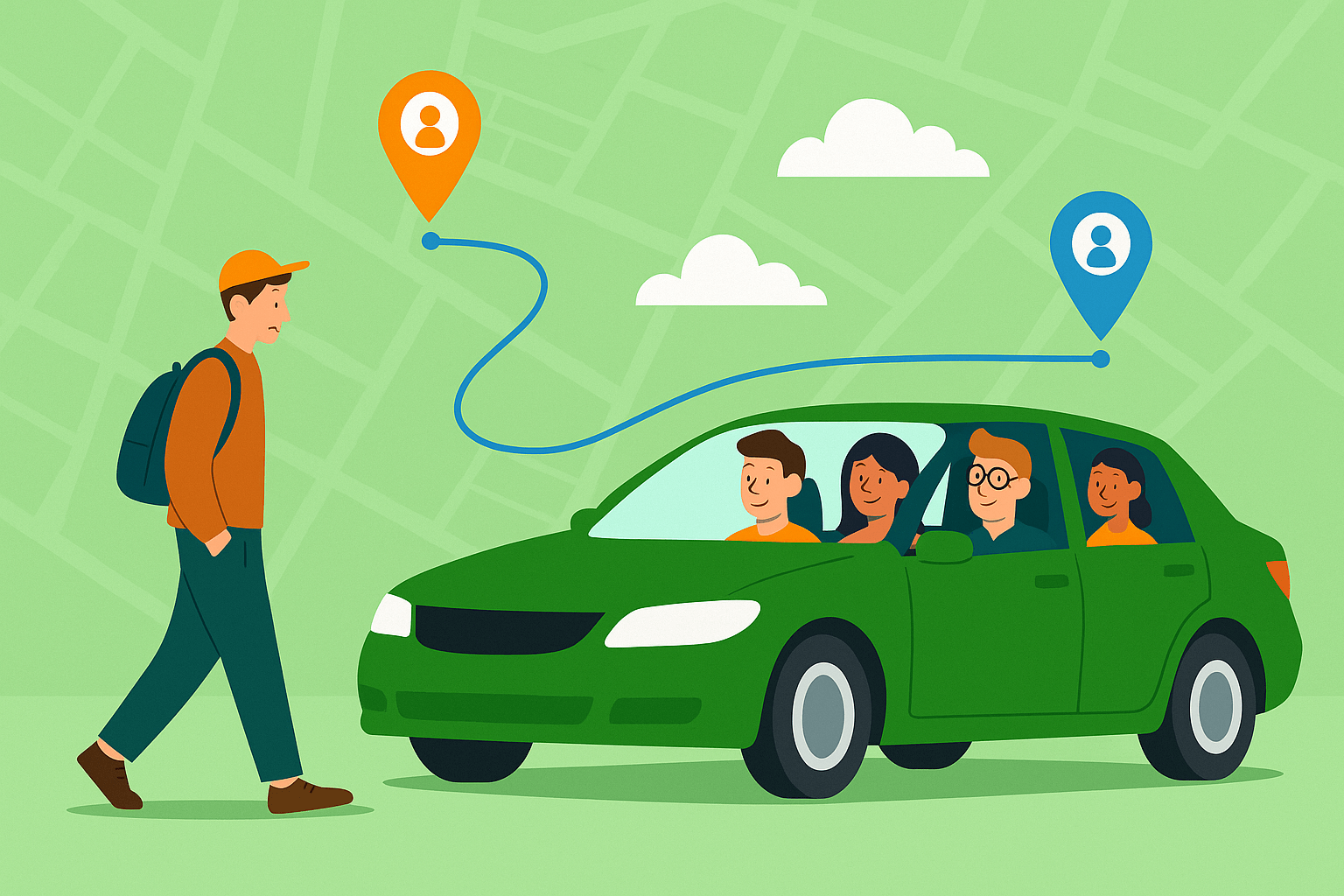
When you share a ride purely to split the cost of a trip you are already taking, you are participating in a non-commercial carpool rather than running a commercial transport service.
The main distinction comes down to driver intent and route control. In a true carpool, the driver has a personal reason to travel to the destination, such as commuting to an office, a university campus, or a job site. In commercial ride-hailing or taxi driving, the passenger chooses the destination and the driver makes the trip to earn an income.
Provincial rules set clear boundaries so ordinary commuters do not need commercial licences or municipal taxi permits to share a ride:
- Shared origin or destination: The driver and passengers are travelling between a common starting area and a common destination as part of the driver's own planned trip.
- Cost recovery only: Passengers only reimburse the driver for a fair share of actual vehicle operating expenses, with no profit margin.
- Incidental frequency: The ride is part of a normal daily schedule, typically one round trip per day between home and work or school.
- Standard licensing: Because the trip is non-commercial, the driver operates under a standard Ontario Class G driver's licence rather than a commercial passenger permit.
When your commute meets these conditions, you are simply sharing a personal trip with peers. Crossing any of those lines turns the ride into a commercial service, which requires municipal licensing and commercial auto insurance.
| Factor | Non-Commercial Carpool | Commercial Ride-Hailing |
|---|---|---|
| Driver Intent | Personal commute to work or school | Earning income from passenger fares |
| Route Choice | Set by the driver's existing schedule | Directed by the passenger on demand |
| Payment Limit | Reimbursement of actual trip costs | Commercial fare plus driver profit |
| Trip Frequency | Incidental to a daily round-trip commute | Multiple on-demand trips per shift |
| Licensing Needed | Standard Class G driver's licence | Municipal commercial permit and endorsement |
Legitimate Cost-Sharing: Splitting Gas, Tolls, and Parking Without Making a Profit
Many Ontario drivers worry that accepting money from a passenger will automatically classify their vehicle as a taxi or ride-hail car. In reality, exchanging money for a ride is completely legal in a carpool as long as the payment is strictly a reimbursement of shared trip costs. You are pooling resources to pay for a journey you are all taking together.
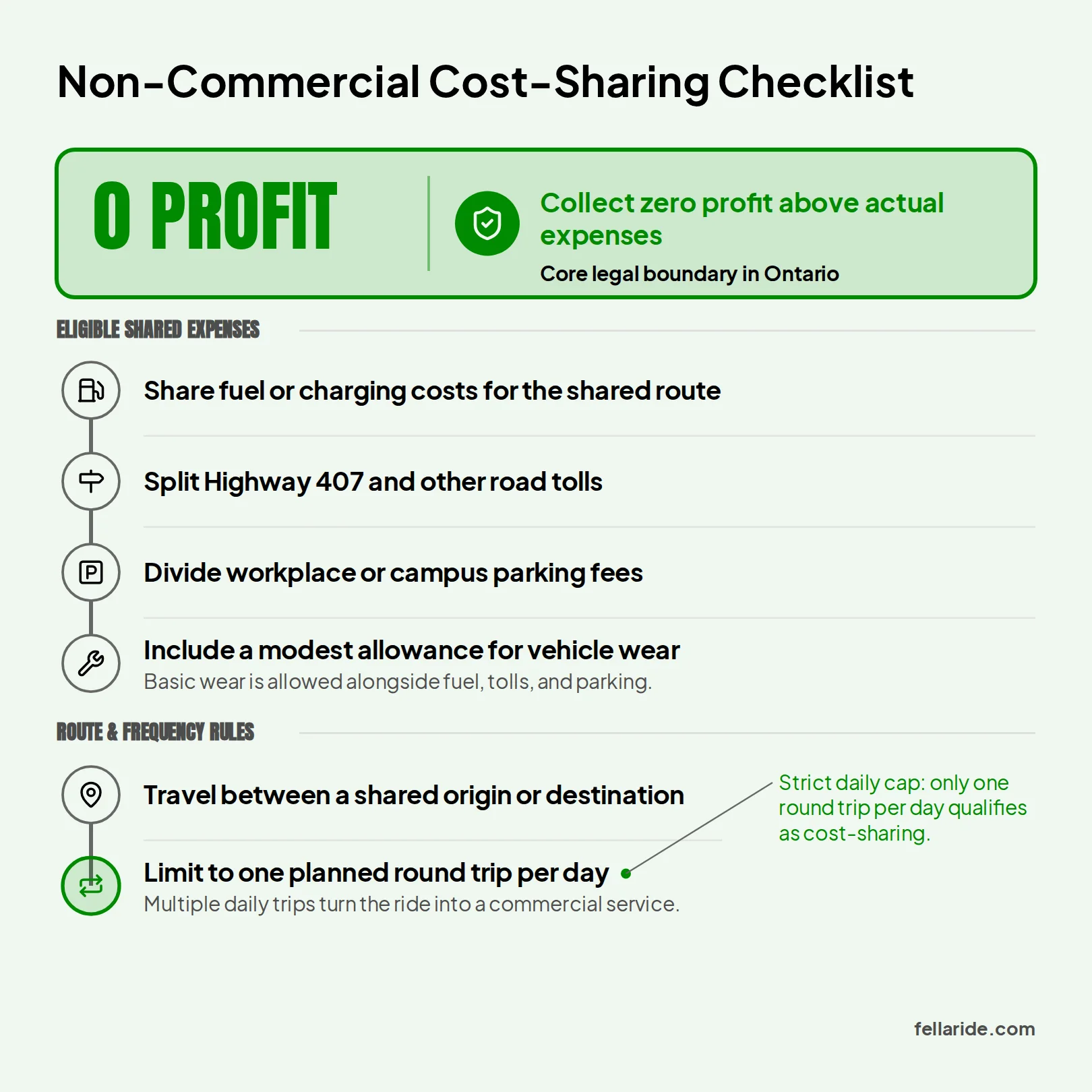
To keep your arrangement clearly within the bounds of legitimate cost-sharing, calculate the actual expenses of the commute and divide them among the people in the vehicle, including the driver. Eligible expenses that commuters commonly split include:
- Fuel consumption: The gas or electricity used for the specific round-trip distance between your pickup point and destination.
- Highway tolls: Electronic toll charges incurred during the shared route, such as trips along Highway 407 ETR.
- Parking fees: Daily or monthly parking passes at your workplace, campus lot, or transit station.
- Routine wear and tear: A modest, reasonable allowance for tire wear, oil changes, and basic vehicle maintenance tied to the commute distance.
How to Keep Reimbursements Fair and Transparent
Suppose a driver commutes daily from Mississauga to a workplace in downtown Toronto. If the driver and riders divide the total cost of fuel and downtown parking equally among everyone in the car, the driver is merely recovering a portion of the trip's actual cost. In fact, the driver is still paying their own share of the commute.
Problems only arise if a driver sets flat fares that exceed the total cost of operating the vehicle for that trip, or packs the vehicle to generate extra cash beyond what the gas, tolls, and parking actually cost. Collecting money above the true operating cost creates a financial profit, which removes the protection of non-commercial carpooling.
Tip: Agree on the exact cost contribution before your first trip starts. Settling up electronically or through a dedicated carpool platform keeps expectations clear and avoids awkward cash handoffs in the car.
How Auto Insurance and Liability Work When You Carpool in Ontario
A common question for anyone starting a workplace or campus carpool is whether carrying paying passengers voids a personal auto insurance policy. In Ontario, all standard personal auto policies use the provincial Ontario Automobile Policy (OAP 1) owner's policy form regulated by the Financial Services Regulatory Authority of Ontario (FSRA).
Under this standard framework, using your personal vehicle for a non-commercial carpool where passengers only share expenses is permitted and does not count as commercial driving.
Standard policies restrict drivers from carrying paying passengers for hire or commercial compensation, such as driving for a commercial ride-sharing service without a special endorsement. However, occasional or daily carpooling where riders simply reimburse a share of gas and parking is recognized as personal or commuting use rather than commercial use.
Before you start driving regular passengers, review three key parts of your policy with your insurance provider or broker:
- Vehicle usage class: Make sure your policy lists your vehicle as being used for commuting to work or school, not purely for pleasure use, and accurately reflects your daily driving distance.
- Third-party liability coverage: Confirm that your liability limit is adequate for carrying multiple passengers on busy provincial highways.
- Driver rotation rules: If you and a coworker take turns driving your own respective cars on alternating days, each driver's own policy covers their own vehicle when it is on the road.
Watch out: If a passenger ever takes a turn driving your car during a long commute, they must hold a valid licence and have your explicit permission, as your vehicle's insurance policy follows the car first in the event of a collision.
Using HOV Lanes and Carpool Parking Lots Across the Greater Toronto Area
Beyond saving money on gas and parking, sharing your daily drive unlocks practical infrastructure perks across Ontario's highway network.
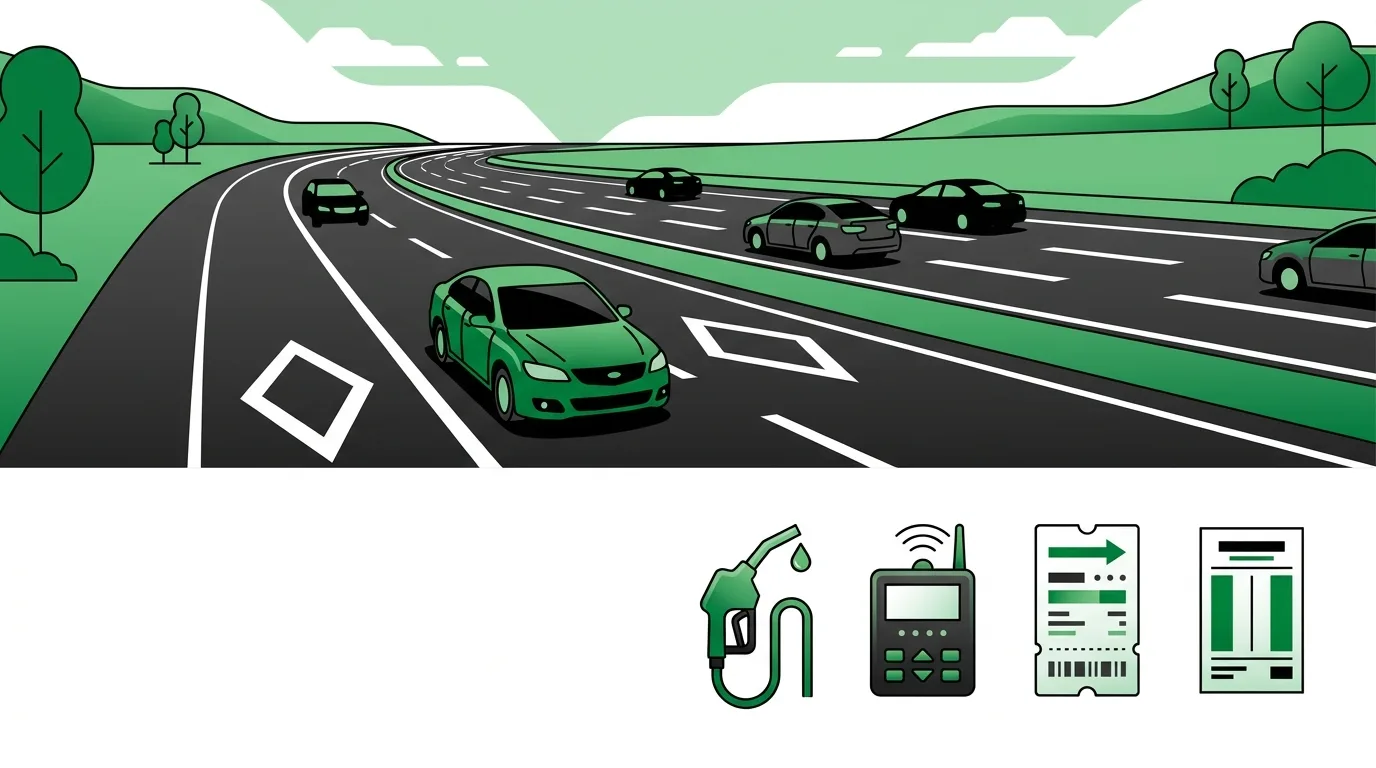
According to the Ministry of Transportation's guide to High Occupancy Vehicle (HOV) lanes on provincial highways, any passenger vehicle carrying at least two people (the driver plus at least one passenger) can travel in designated HOV lanes on 400-series highways across the GTA, including Highways 403, 404, and 410, as well as the QEW.
Using HOV lanes properly requires following specific entry, exit, and occupancy rules enforced by provincial police:
- Minimum occupancy: You must have at least two occupants in the vehicle unless you are driving an eligible vehicle displaying valid green licence plates or a provincial permit.
- Striped buffer zones: Never cross the solid double lines or striped buffer markings that separate the HOV lane from general traffic lanes.
- Designated access points: Enter and exit the HOV lane only where broken white lines indicate an official merge zone.
Meeting Up at Provincial Carpool Parking Lots
If you and your carpool partners live in different neighbourhoods, the driver does not need to detour through residential streets to pick everyone up at their front doors. Ontario maintains free provincial carpool parking lots near highway interchanges where commuters can leave their extra vehicles and consolidate into one car before merging onto the highway.
Most provincial carpool lots offer free parking for up to five consecutive days, lighting, and direct access to major corridors like Highway 401, Highway 400, and the QEW. Meeting at a central interchange lot keeps the driver's route direct and saves time for everyone in the car.
How Trusted Workplace, Campus, and Community Groups Simplify Daily Commutes
Finding reliable people who share both your route and your work hours is often the hardest part of setting up a carpool. Posting on public classified boards or open social media groups can feel uncertain because you know very little about the person on the other end of the message.
Commuters across the Greater Toronto Area increasingly prefer organizing rides within closed, verifiable communities such as a shared employer, a university campus, or a local neighbourhood group.
Matching within a workplace or campus network solves the logistical hurdles of carpooling before you ever step into a vehicle:
- Built-in accountability: Sharing a ride with someone who works in your office park or attends the same college creates natural mutual trust and shared professional standards.
- Aligned schedules: Coworkers on the same shift and students with matching lecture blocks naturally travel at the same times each morning and evening.
- Consistent pickup points: Because everyone is heading to the exact same building or campus lot, drop-offs require zero extra detours.
- Preset cost-sharing: Commuters can see the proposed cost split upfront and agree on terms without haggling over gas money.
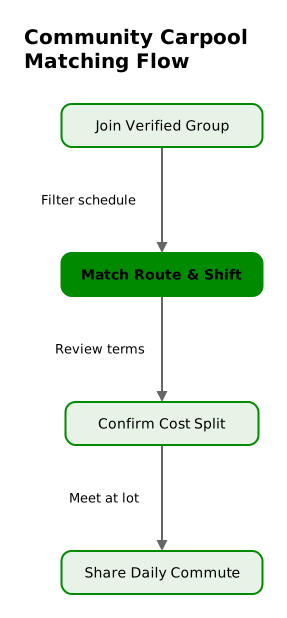
Once a match is made inside a trusted group, turning a solo drive into a shared routine follows a predictable daily flow.
Practical Safety and Etiquette Tips for Drivers and Passengers
A smooth carpool depends on clear communication and mutual respect for everyone's time. Because morning traffic in the GTA leaves very little margin for delay, setting simple ground rules on day one keeps your carpool group running reliably week after week.
Follow these practical safety and etiquette habits whether you are behind the wheel or riding as a passenger:
- Verify profiles before meeting: Check your carpool partner's workplace, school, or community profile and exchange phone numbers before your first morning pickup.
- Set a waiting grace period: Agree on a firm departure window, such as waiting up to five minutes past the scheduled pickup time, so one late person does not make the whole car late for work.
- Communicate schedule changes early: Let your driver or passengers know the evening before if you are staying late at the office, working from home, or taking a sick day.
- Keep the cabin comfortable: Discuss simple preferences early on, including cabin temperature, morning music or podcast volume, and whether eating or drinking coffee in the car is welcome.
- Inspect winter readiness: During Ontario winters, drivers should keep washer fluid topped up, install winter tires, and clear all snow and ice from windows before picking up passengers.
When everyone knows the pickup spot, the departure window, and the shared cost before the week begins, carpooling transforms an expensive solo highway grind into a predictable, stress-free commute.
FAQ
Do I have to report carpool reimbursements as taxable income in Canada?
When passengers simply reimburse you for their fair share of actual commuting costs such as gas, tolls, and parking on a personal trip, there is no net profit. Because true cost-sharing merely reduces your personal out-of-pocket commuting expense rather than generating income, it is treated as expense reimbursement rather than business earnings.
Can I use a leased or financed car for a workplace carpool in Ontario?
Yes, personal vehicle leases and auto loans in Ontario allow normal personal and commuting use, which includes non-commercial carpooling with coworkers or fellow students. Only commercial driving for hire, such as operating as a taxi or commercial ride-hail vehicle, is typically restricted by standard personal lease agreements.
What happens if my regular carpool driver gets stuck late at work?
Most regular commuters establish a backup plan before they start riding together, such as taking GO Transit home or catching a ride with another colleague in the same workplace carpool group. Communicating potential overtime early in the afternoon gives passengers plenty of time to adjust their evening travel plans.
Do children or infants count toward the two-person minimum for Ontario HOV lanes?
Yes, Ontario's HOV lane rules count every human occupant inside the vehicle toward the minimum two-person requirement, regardless of age. A driver travelling with one child or infant in a car seat is legally permitted to use provincial HOV lanes.