Shift Worker Commutes: Ridesharing for Logistics Hubs
TL;DR
- Statistics Canada reports public transit commutes average 42.2 minutes versus 24.5 minutes by car, and off-peak warehouse shifts widen that gap.
- FellaRide matches shift coworkers inside private Organizational (ORG) or Moderator-Controlled (MOD) Trusted Groups with zero platform commissions.
- Hosts and Guests split actual fuel, toll, and parking expenses upfront, eliminating last-minute ride-hail surge costs and dark last-mile walks.
- Logistics employers boost participation by pairing workplace carpool groups with a simple Guaranteed Ride Home safety net.
Share Your Shift Commute With Verified Coworkers
Join a private workplace Trusted Group on FellaRide to match routes by shift time and split fuel costs with zero platform commissions.
Why Warehouse and Logistics Hubs Present Unique Shift Commute Hurdles
Clocking out of a distribution centre at midnight or starting a warehouse shift before dawn often means stepping into a public transit void. Across the Greater Toronto Area, from Mississauga to Scarborough, major logistics corridors and employment zones sit far away from rapid subway terminals.
Even when a regional train brings you near an industrial park, covering the remaining distance usually requires a slow feeder bus and a 20-minute walk in the dark along wide arterial roadways.
National records show how wide this daily travel gap has become for shift workers. According to Statistics Canada commuting data, transit riders need an average of 42.2 minutes to reach work while car commuters average 24.5 minutes, and nearly 1.5 million Canadians travel an hour or more each way.
That gap expands outside nine-to-five schedules when evening warehouse shifts end just as municipal agencies cut bus frequency to thirty-minute or hourly intervals.
When shift changes happen late at night or early in the morning, four structural hurdles turn the final stretch into a daily stressor:
- Reduced late-night frequency: Suburban bus routes scale back service after evening peaks, turning a brief daytime transfer into a long, cold wait.
- Missing industrial sidewalks: Many logistics parks and commercial plazas sit along corridors where paved pedestrian paths stop abruptly.
- After-dark safety risks: Walking alone from a distant transit drop-off point late at night leaves workers feeling vulnerable.
- Multi-transfer fatigue: Switching from a local feeder route to a train and then another bus multiplies the risk of getting stranded.
Community-based carpooling bridges this last-mile gap because a Host is a fellow coworker already travelling from your neighbourhood to the exact same workplace corridor. A Guest can bypass intermediate transit transfers and ride directly from a local pickup spot to the distribution centre entrance.
The Financial Toll of Off-Peak Transit Gaps and Emergency Ride-Hailing
A monthly transit pass appears reasonable on a household budget sheet, yet the actual cost of reaching a suburban warehouse often hides between regional boundaries. Crossing municipal lines between Mississauga, Brampton, Vaughan, Markham, and Toronto introduces transfer rules and extra fare legs that quickly complicate weekly travel budgets.
Unpredictable off-peak transit also forces shift staff into costly emergency choices when a late connection puts a warehouse shift at risk:
- Last-minute commercial rides: Ordering an on-demand taxi or ride-hail car during peak hours or bad weather triggers surge pricing that can wipe out a full day of part-time earnings in one trip.
- Lost shift wages: Punching in late to a warehouse, hospitality, or retail shift because of a cancelled feeder bus results in docked hours or reassigned shifts.
- Cross-boundary fare stacking: Travelling across separate regional transit networks can trigger additional fare charges depending on the route and pass structure.
- Time poverty: Spending hours in multi-transfer transit every day leaves fewer hours for rest, meal preparation, and paid work.
FellaRide replaces sudden surge fares with a zero-commission peer-to-peer cost-sharing model that operates without tier-based subscription packages. By dividing fuel, highway tolls, and parking permits among coworkers already driving the same corridor, a Host offsets regular vehicle upkeep while a Guest secures an affordable, predictable seat.
Peer-to-peer carpooling balances predictable cost-sharing with direct parking lot arrivals for off-peak warehouse shifts.
| Commute Factor | Solo Driving | Transit Plus Emergency Ride-Hail | Peer-to-Peer Carpooling |
|---|---|---|---|
| Cost predictability | Full solo fuel and upkeep | Base fares plus surge spikes | Preset fuel and toll split |
| Schedule alignment | Depart anytime | Fixed off-peak timetable | Aligned shift departure window |
| Route requirements | Works on any road | Fixed transit corridors | Best on busy highway corridors |
| Last-mile arrival | Direct to workplace lot | Feeder bus plus dark walk | Direct to workplace lot |
Tip: Save your warehouse lot and nearest salted arterial intersection in Favorite Places so you can post or search recurring shift rides in seconds.
How Private Workplace Trusted Groups Match Hosts and Guests by Shift
For years, setting up a workplace carpool meant pinning a paper note to a breakroom board or messaging open social media groups, only for the arrangement to collapse whenever a coworker called in sick or rotated shifts. Relying on public classified boards also feels uncertain because commuters know very little about the person answering the post.
FellaRide replaces scattered group chats with Communities and Trusted Groups tailored to verified adults aged 18 or older. Distribution centres and regional employers can organize shift carpools through specific community structures and core mobile tools:
- Organizational (ORG) communities: Restricted to members who verify an approved workplace or institutional email domain.
- Moderator-Controlled (MOD) communities: Private or semi-private circles that require moderator approval before a worker can join.
- Global (Open) and Interest Based Communities: Open networks that commuters enter immediately across regional corridors or shared hobbies.
- Post a Ride and Ride Requests: Hosts publish one-time or recurring trips with available seats and vehicle details, while a Guest can post a ride request or open Search a Ride to filter by date, route, and community.
- User Profile Verification and Favorite Places: Optional one-time passcodes and email domain checks award profile trust badges, while saved destination markers speed up daily route posting.
As highlighted in Natural Resources Canada's fuel-efficient driving guide, sharing a vehicle with other commuters directly lowers personal fuel consumption and eases road congestion. When operations managers launch an employee carpool program, they can configure network rules that match how warehouse teams actually operate:
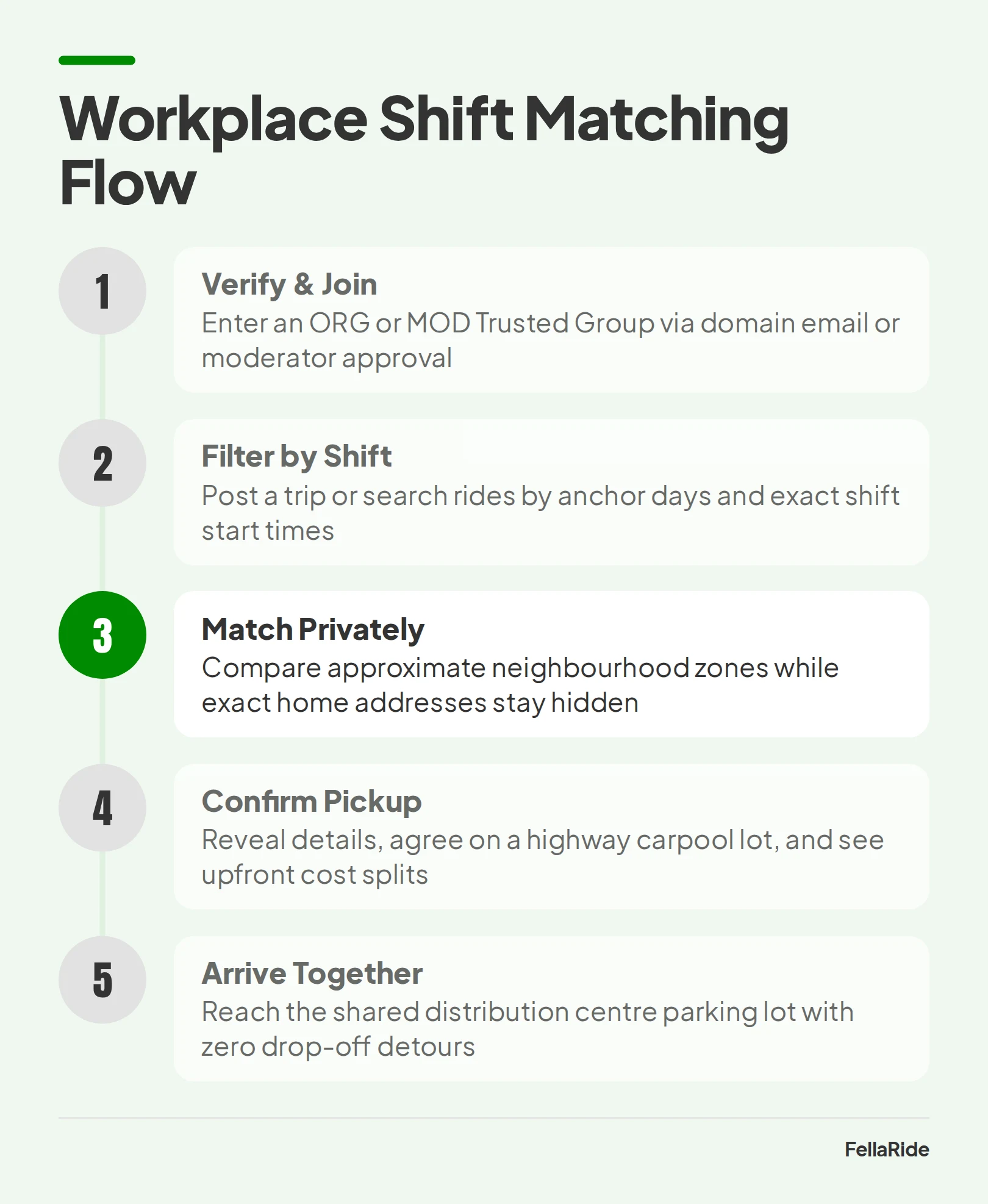
- Shift and anchor-day filters: Allow rotating and hybrid staff to filter ride offers by specific days of the week or exact shift start times.
- Commuter preferences: Let members note quiet-ride expectations, music tastes, or highway carpool lot meeting points.
- Privacy controls: Show approximate route overlap and neighbourhood zones instead of exact home street addresses until both commuters confirm the match.
Matching inside a verified workplace group delivers built-in accountability, zero drop-off detours since everyone arrives at the same lot, and upfront cost calculations. If a policy violation or safety issue ever occurs, members can submit a report to support through In-App Dispute Reporting.
Configuring Corridor Pickups and Winter Backup Plans for Early and Late Shifts
Peer-to-peer carpooling works alongside regional rail and bus networks rather than replacing them. Shift workers across Brampton, Markham, and Mississauga use shared rides to travel directly from suburb to suburb without routing through downtown Toronto, or to bridge the first-mile link to a regional rail terminal. Check our Brampton to Toronto and Mississauga carpool guide to see how corridor commuters coordinate highway pickups.
Commuters frequently meet at provincial highway carpool parking lots right beside major interchanges to park a second vehicle and enter high-occupancy vehicle lanes together. You can explore FellaRide community groups to find verified shift commuters along your corridor. To verify profiles and coordinate live arrivals in the app, every participant needs a compatible smartphone, active GPS location services, and reliable mobile data.
Watch out: Confirm your exact pickup landmark and waiting window inside the app the night before an early shift, and carry a backup transit card in your work bag in case an unscheduled late shift changes your departure time.
Overnight snowfalls create extra challenges for early warehouse shifts because residential crescents and cul-de-sacs are plowed last, and turning into three unplowed subdivisions can add 15 minutes or trap a loaded sedan in deep ruts. Review our guide to preparing your GTA carpool for winter weather and hold a five-minute group review in early November to lock in four habits before mid-November:
- Map arterial snow-day corners: Pick a salted main-road gas station, transit shelter, or coffee shop lot within a five-minute walk of each Guest's home for Yellow Window mornings.
- Adjust for winter fuel and wash costs: Add a modest seasonal contribution to cover higher cold-weather fuel burn, washer fluid jugs, and underbody salt washes.
- Set snow-day cancellation terms: Agree upfront whether members still split fixed weekly parking passes when a Red Window storm closes the road.
- Protect the cabin with rubber mats: Fit high-walled rubber floor mats in front and rear footwells, and ask every Guest to tap snow off their work boots before stepping inside.
Non-Commercial Cost-Sharing Rules and Insurance Basics for Canadian Shift Carpools
Understanding the legal boundary between a peer-to-peer shift carpool and a commercial taxi or ride-hail service keeps both Hosts and employers protected. In a true cost-sharing arrangement, the Host is already driving to the warehouse or campus for their own work shift and simply fills empty seats to reimburse actual trip costs without making a profit.
You can read the full breakdown of how non-commercial carpooling works in Ontario and review platform guidelines in the FellaRide Help Center before setting up a regular shift rotation. Because the trip is incidental to a daily round-trip commute and collects no commercial fare or platform commission, a Host operates under a standard Class G licence rather than a municipal commercial permit.
Non-commercial shift carpooling reimburses actual commute expenses on a Host's existing work schedule without commercial permits or profit.
| Rule Category | Shift Cost-Sharing Carpool | For-Hire Ride Service |
|---|---|---|
| Purpose of trip | Host's own commute to work or campus | Generating revenue from rider fares |
| Path selection | Follows Host's preset shift timetable | Chosen by rider at booking time |
| Cost ceiling | Covers actual shared travel expenses | Retail tariff with added profit margin |
| Ride cadence | Tied to one daily round-trip work run | Repeated back-to-back dispatches |
| Required credential | Regular Class G licence | City for-hire permit and endorsement |
How Logistics Employers Support Shift Carpools with Guaranteed Ride Home Policies
Even when a warehouse team wants to split fuel expenses, the biggest hesitation workers have about leaving a personal vehicle at home is the fear of getting stranded at the facility. If a child falls ill at school, a floor supervisor requests unscheduled overtime, or a Host has to depart early, the Guest still needs a dependable way home.
Operations and HR leaders remove that hesitation by pairing their workplace carpool network with a Guaranteed Ride Home (GRH) policy and reserved lot stalls. When an unexpected emergency breaks up a confirmed carpool, the employer pays for the Guest's return trip via taxi, rideshare, or regional transit such as GO Transit. Employers can also improve office parking management by allocating spots to carpools near the main warehouse entrance.
Most workplaces find that actual reimbursement requests stay low once shift staff know a clear safety net is in place:
- Verified carpool eligibility: Require a logged carpool arrival at the facility on the day the emergency return ride is requested.
- Predictable annual cap: Set a fixed yearly limit on the number of emergency trips per worker so the HR budget remains predictable.
- Fast voucher or expense payout: Distribute pre-approved rideshare vouchers through HR or reimburse transit and taxi receipts on the next payroll expense cycle.
Learn more about FellaRide
FAQ
Does a Host need a commercial licence to drive coworkers to a warehouse shift?
No, a Host only needs a standard Class G licence when sharing a personal commute to work or school in Ontario. As long as the route follows the Host's existing shift schedule and payments only reimburse actual trip expenses without profit, the ride remains non-commercial.
How does FellaRide keep workplace shift groups private?
FellaRide offers Organizational (ORG) groups restricted to approved workplace email domains and Moderator-Controlled (MOD) groups that require manual sign-off before joining. Within the matching network, privacy controls display approximate neighbourhood overlap instead of exact home street addresses until two coworkers agree to ride together.
What happens if a Guest is asked to work unscheduled overtime at the distribution centre?
Commuters should keep a backup transit card in their work bag for sudden schedule changes. In workplaces with a Guaranteed Ride Home policy, the employer covers the Guest's trip home via rideshare, taxi, or regional transit like GO Transit when manager-requested overtime breaks up a confirmed carpool.
Does FellaRide charge commissions or monthly subscription fees for shift carpools?
No, FellaRide charges zero commissions on shared peer-to-peer rides and operates without tier-based subscription packages. Hosts and Guests simply divide actual travel expenses such as fuel, highway tolls, and parking passes.
Sources
Learn more about FellaRide