Smart Office Parking Management for Employee Carpools
fellaride.com
Coordinate workplace carpools and priority parking with FellaRide
Visit fellaride.com →TL;DR
- Audit Tuesday through Thursday stall occupancy and map anonymized employee postal codes to spot overlapping highway commute corridors.
- Convert front-row parking spaces near the main entrance into reserved carpool stalls with posted morning release times.
- Use geofenced co-arrival tracking and licence plate matching to validate shared trips automatically without checking paper hangtags.
- Pair reserved carpool parking with a clear Guaranteed Ride Home policy so guests never worry about being stranded at work.
Build a verified workplace carpool network
Connect coworkers in private Trusted Groups to share highway commutes, split travel costs without profit, and ease mid-week parking congestion.
What you need
Pulling into a suburban office park on a Tuesday morning only to circle a full surface lot frustrates staff before the workday even starts. As hybrid teams align their anchor days, mid-week parking crunches create an operational bottleneck for facilities and HR leaders. Before repainting stalls or issuing permits, gather these foundational inputs across your workplace teams:
- Anonymized postal code records: Export the first three characters of employee home postal codes from HR records to identify geographic commuter clusters without exposing private street addresses.
- Current parking lot layout diagram: Map out your surface lot or garage showing total capacity, accessible spaces, visitor stalls, and primary building entrances.
- Baseline commuter survey form: Prepare a short questionnaire to capture current travel modes, preferred hybrid office days, and typical arrival and departure windows.
- Digital carpool matching system: Select a platform that verifies corporate email domains, pairs coworkers along shared highway corridors, and records joint arrivals.
- Signage and safety-net budget: Secure approval for lot signs, optional toll or fuel perks, and emergency ride vouchers.
- Designated program coordinator: Assign a clear owner in facilities or HR to oversee stall zoning, employee communications, and monthly stall adjustments.
Tip: Focus your initial carpool matching on coworkers who travel the same highway corridor and share the same department anchor days.
1. Audit peak parking demand and map employee commute corridors
Start by measuring how your parking lot actually performs across the workweek rather than relying on total headcount. Have security or facilities staff count occupied stalls on Tuesday, Wednesday, and Thursday mornings, then compare those mid-week peaks against Monday and Friday usage. This baseline shows exactly how many single-occupancy cars you need to consolidate on anchor days.
Next, plot your anonymized postal code clusters against your workplace address to see which regional highways carry the majority of your workforce. Look for natural geographic funnels where employee routes overlap even when staff live in different municipalities. Commuters travelling along the same major highway corridor on the same departmental anchor days form your strongest initial carpool matches.
Follow up your map audit with a brief employee survey to confirm daily travel habits and route preferences. When you launch an employee carpool program in the GTA, ask staff five specific questions to ground your parking plan:
- Primary travel mode: Confirm how they currently reach the office on most in-office days.
- Typical weekly schedule: Record their standard arrival window, departure time, and team anchor days.
- Main highway corridors: Identify which major routes or toll highways they travel along.
- Pickup location preference: Check whether they prefer neighbourhood pickups or meeting at Ontario Ministry of Transportation carpool parking lots, which offer free parking at highway interchanges.
- Preferred carpool role: Ask whether they want to host rides in their own vehicle, ride as a guest, or alternate driving duties.
Consolidating these overlapping highway trips also improves your environmental reporting. Under the Greenhouse Gas Protocol Scope 3 Category 7 guidance, employers can use commuter survey data and verified shared trip distances to calculate employee commuting emissions accurately.
2. Zone your parking lot with dedicated front-row carpool stalls
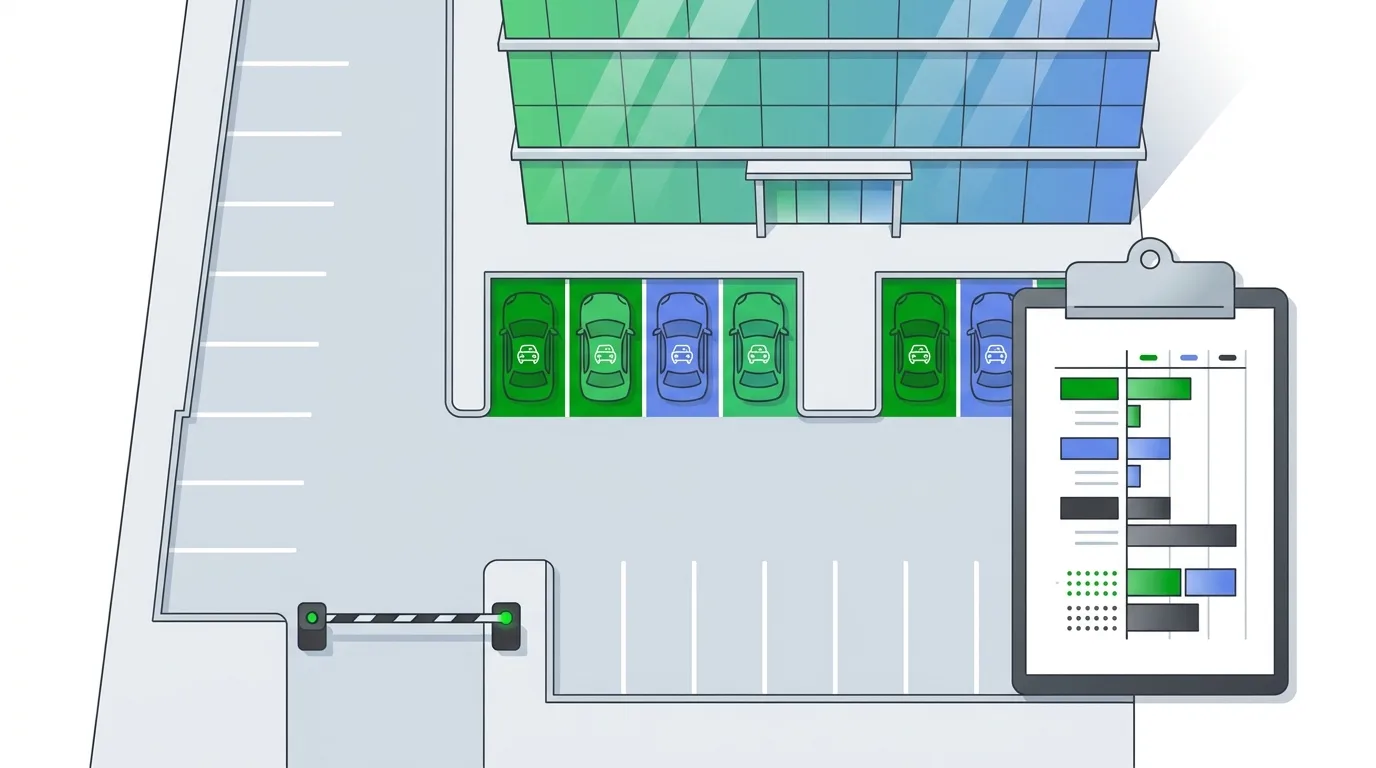
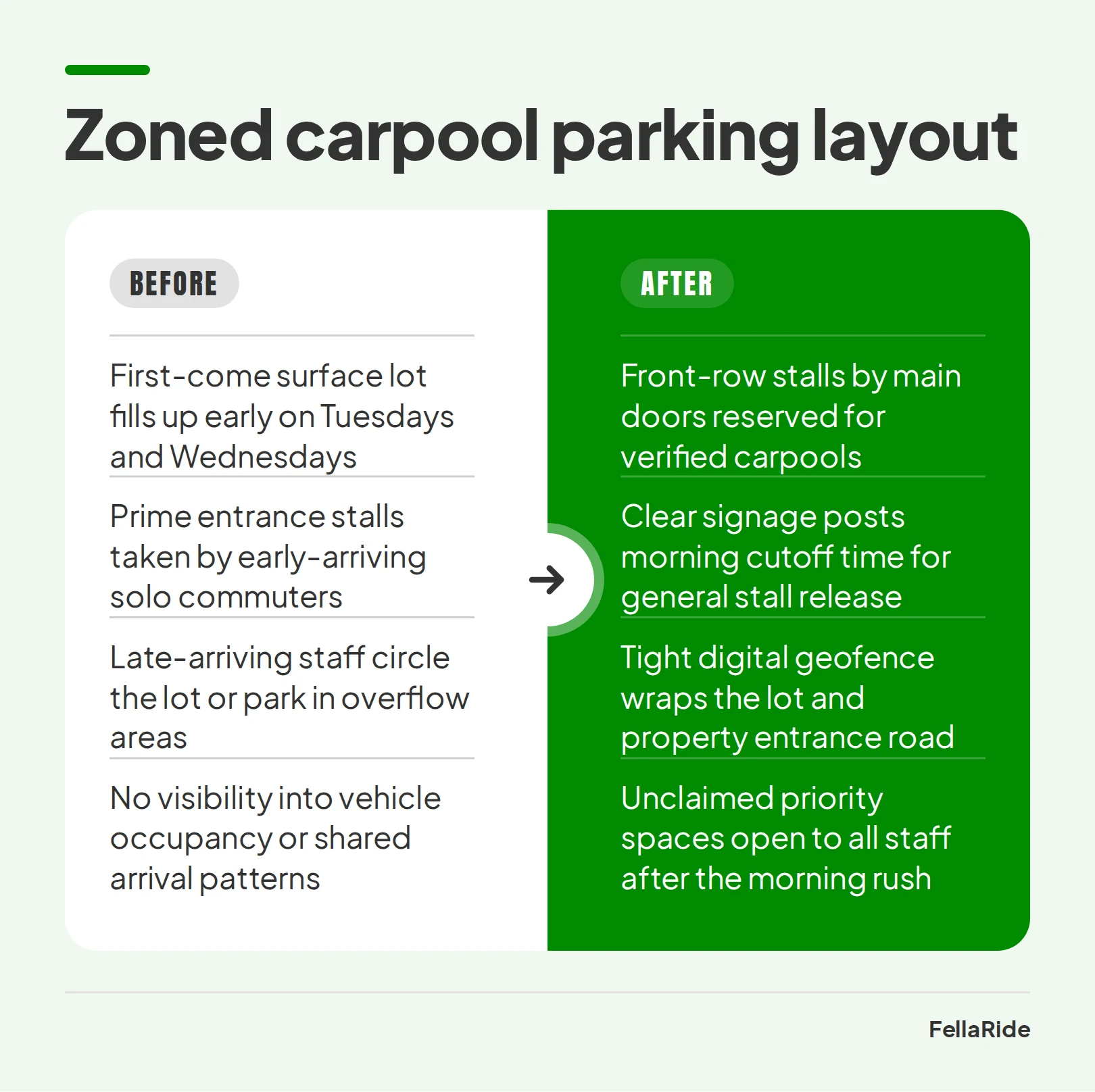
Once you know how many shared vehicles your workforce can form, redesign your parking layout to reward multi-occupant cars immediately. Convert a dedicated block of prime stalls right next to the main building entrance into reserved carpool spaces. Placing these stalls by the front door costs little beyond signage, yet saves commuters a long walk across an icy lot in winter.
Install high-visibility signs at the head of each priority stall stating that the space is reserved for verified carpools until a specific morning cutoff time. Clear physical zoning prevents confusion during the morning rush and signals to solo commuters that sharing a ride earns an immediate daily perk.
Start with a conservative number of reserved spaces based on your initial survey commitments, then expand the priority zone as adoption grows. Keeping the zone rightsized ensures that solo commuters see active carpools filling those front-row stalls every Tuesday and Wednesday morning rather than staring at empty pavement.
How to position priority stalls for smooth morning traffic flow
- Cluster near primary doors: Group carpool spaces directly beside accessible and visitor stalls closest to badge-entry doors.
- Post morning release times: Display the exact hour when unclaimed carpool stalls open to general employee parking so no concrete sits empty all afternoon.
- Map a tight digital geofence: Draw your virtual arrival boundary around the parking lot and entrance driveway so automated check-ins capture arriving cars accurately.
Watch out: Keep your virtual geofence perimeter tight around your lot and property entrance roads so it does not accidentally capture adjacent highways or public transit stops where employees pass by separately.
3. Set occupancy rules, morning cutoff times, and carpool incentives
Employees stick with shared commuting when the qualification rules are transparent and enforcement feels fair to everyone. Document your ground rules in a short one-page workplace policy before opening the priority stalls. Spell out minimum vehicle occupancy, morning release windows, and non-commercial cost-sharing guidelines so coworkers never have to negotiate money awkwardly in the car.
Understanding how non-commercial carpooling works in Ontario helps HR teams write clear cost-splitting formulas that cover genuine fuel and toll expenses without commercial profit. Sharing clear carpool etiquette and ground rules also helps coworkers align on pickup grace windows and cabin preferences before day one.
Beyond front-row parking, small workplace perks help sustain momentum during winter months or busy project quarters. Offering a 15 to 30 minute flexible arrival window gives shared vehicles breathing room when highway traffic slows down, while monthly prize draws reward consistent participants without adding permanent fixed costs.
When choosing how to allocate spaces and reward participants, balance the employee benefit against the administrative workload required from facilities and HR:
Automated trip logs and cutoff signs let teams enforce carpool parking with minimal effort.
| Allocation rule or perk | Employee benefit | Verification method | Admin effort |
|---|---|---|---|
| Front-row carpool stalls | Prime spot by main entrance | Geofenced co-arrival and plate check | Low |
| Morning cutoff release | Open access to unused stalls | Posted cutoff time on stall signage | Low |
| Fuel or toll credit | Monthly gas or highway toll card | Automated shared trip log | Medium |
| Flexible arrival window | 15–30 min pickup grace period | Manager schedule alignment | None |
| Monthly commuter raffle | Entry into workplace prize draw | Monthly verified trip report | Low |
4. Automate parking spot allocation and arrival verification with trip data
Nothing erodes trust in a workplace parking program faster than solo commuters parking in reserved carpool spaces without consequence. At the same time, facilities leaders do not want security personnel standing outside in freezing weather checking paper hangtags every morning. Connecting geofenced arrival tracking to your carpool platform solves enforcement automatically.
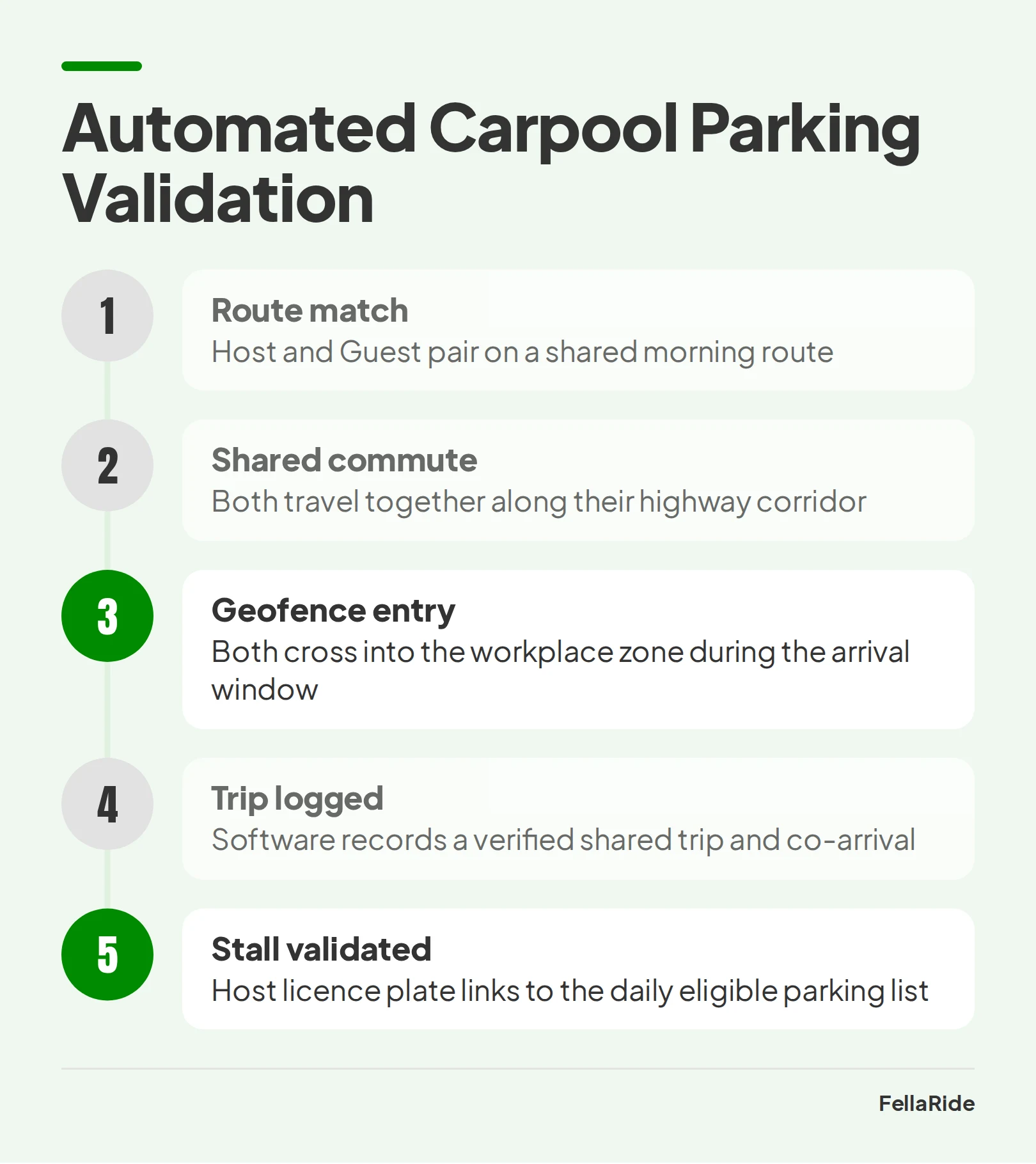
Instead of static plastic permits that anyone can leave on a dashboard when commuting alone, digital verification validates each morning trip dynamically. When a matched Host and Guest travel together along their corridor and cross into your workplace geofence during the morning arrival window, the software logs a verified shared trip.
By linking the Host's vehicle licence plate on file to the day's verified co-arrival list, facilities teams can confirm stall eligibility in seconds. Encourage staff who share anchor days to set up recurring multi-day commutes so their parking eligibility updates automatically every Tuesday, Wednesday, and Thursday.
Automated trip logs also remove guesswork when auditing your lot capacity each month. Reviewing verified arrival counts alongside stall utilization shows facilities teams whether to convert another row of standard spaces into priority carpool stalls or adjust the morning release cutoff by 15 minutes.
5. Pair priority parking with a guaranteed ride home policy
Even with a front-row parking spot waiting at the office, the biggest hesitation employees have about leaving their own car at home is the fear of getting stranded. If a child falls ill at school, a manager requests unscheduled late-afternoon overtime, or the Host has to leave early for an emergency, the Guest needs a dependable way home.
Establishing a Guaranteed Ride Home (GRH) policy removes that daily anxiety while keeping program costs predictable. Most employers find that actual reimbursement claims stay low once staff know the safety net is in place. Structure your workplace GRH rules around four clear standards:
- Verified morning eligibility: Require a logged carpool arrival at the workplace on the exact day the emergency ride home is requested.
- Defined eligible emergencies: Cover personal or family illness, unexpected manager-requested overtime, or a Host departing early due to an emergency.
- Predictable annual cap: Set a clear yearly limit on emergency rides per employee so the facilities or HR budget stays controlled.
- Fast voucher or expense payout: Provide pre-approved rideshare or regional transit vouchers through HR, or reimburse submitted receipts on the very next expense cycle.
Ask department managers to mention both the reserved front-row stalls and the Guaranteed Ride Home policy whenever they schedule team anchor days. When employees see that leadership supports both the morning arrival grace window and an emergency backup ride, hesitant solo commuters feel confident leaving their extra car at home.
6. How FellaRide helps workplaces coordinate carpool groups and relieve parking pressure
FellaRide helps employers replace static spreadsheets with private Trusted Groups where staff verify their profiles through corporate email domain checks and one-time passcodes, post one-time or recurring rides, or publish Ride Requests along corridors like the 401, QEW, and 404.
Connecting geofenced arrival tracking to your FellaRide workplace network logs verified co-arrivals when a matched Host and Guest cross into your lot together, tying the Host's licence plate to the daily eligible parking list and recording trip counts and one-way distances for Scope 3 Category 7 commuting reports.
When rolling out your priority parking stalls, treat the launch as an interactive workplace event rather than a single email blast. Host a short morning mixer in the cafeteria where coworkers grouped by highway corridor can meet face to face before sharing a ride, and share first-month stall savings to encourage solo commuters to join.
Review your lot occupancy and verified trip counts at the end of every month to keep your parking layout responsive. Publishing simple internal updates on how many front-row spaces stayed active and how many single-occupancy cars were taken off the lot builds lasting support across facilities, HR, and executive leadership.
Learn more about FellaRide
FAQ
What happens to reserved carpool parking stalls that remain empty after the morning rush?
Post a clear morning cutoff time on every reserved stall sign so any unclaimed carpool spots open to general employee parking after peak arrival hours. This ensures front-row spaces reward morning carpoolers without leaving prime stalls empty during the afternoon.
How do facilities teams stop solo commuters from parking in priority carpool spaces?
Instead of static paper hangtags that can be used when commuting alone, connect a virtual geofence around your lot to a digital matching platform. When a matched Host and Guest cross into the geofence within the same arrival window, the system logs a verified trip and links the vehicle licence plate to that day's eligible parking list.
How can we protect employee privacy when mapping home locations for carpool corridors?
Export only the first three characters of employee home postal codes from your HR records rather than full street addresses. Plotting these forward sortation areas alongside a brief opt-in commuter survey shows which regional highways carry your team while keeping residential details private.
What if an employee who carpooled to work has a family emergency or unexpected overtime?
A Guaranteed Ride Home policy covers the Guest's trip home via rideshare, taxi, or regional transit when an unexpected emergency or manager-requested overtime breaks up a confirmed carpool. Requiring a verified morning carpool arrival and setting an annual cap per employee keeps the budget predictable.
Learn more about FellaRide