Ontario Commuter Carpool Guide: GTA to Ottawa & Niagara
fellaride.com/communities
Explore verified Campus and Workplace Trusted Groups across Ontario
Visit Trusted Communities Hub →TL;DR
- Non-commercial carpooling in Ontario lets a Host and Guests split actual fuel, Highway 407 tolls, and parking costs on a planned trip without profit.
- Carrying at least two people unlocks 400-series HOV lanes (Highways 403, 404, 410, and QEW) and provincial carpool parking lots across the GTA.
- Standard Ontario OAP 1 personal auto policies cover cost-sharing carpools when the vehicle is rated for commuting and carries adequate third-party liability.
- FellaRide connects commuters aged 18+ inside up to 5 verified Campus, Workplace, or Regional Trusted Groups for daily or intercity travel.
Learn more about FellaRide
What Is a Rideshare vs Non-Commercial Carpooling in Ontario
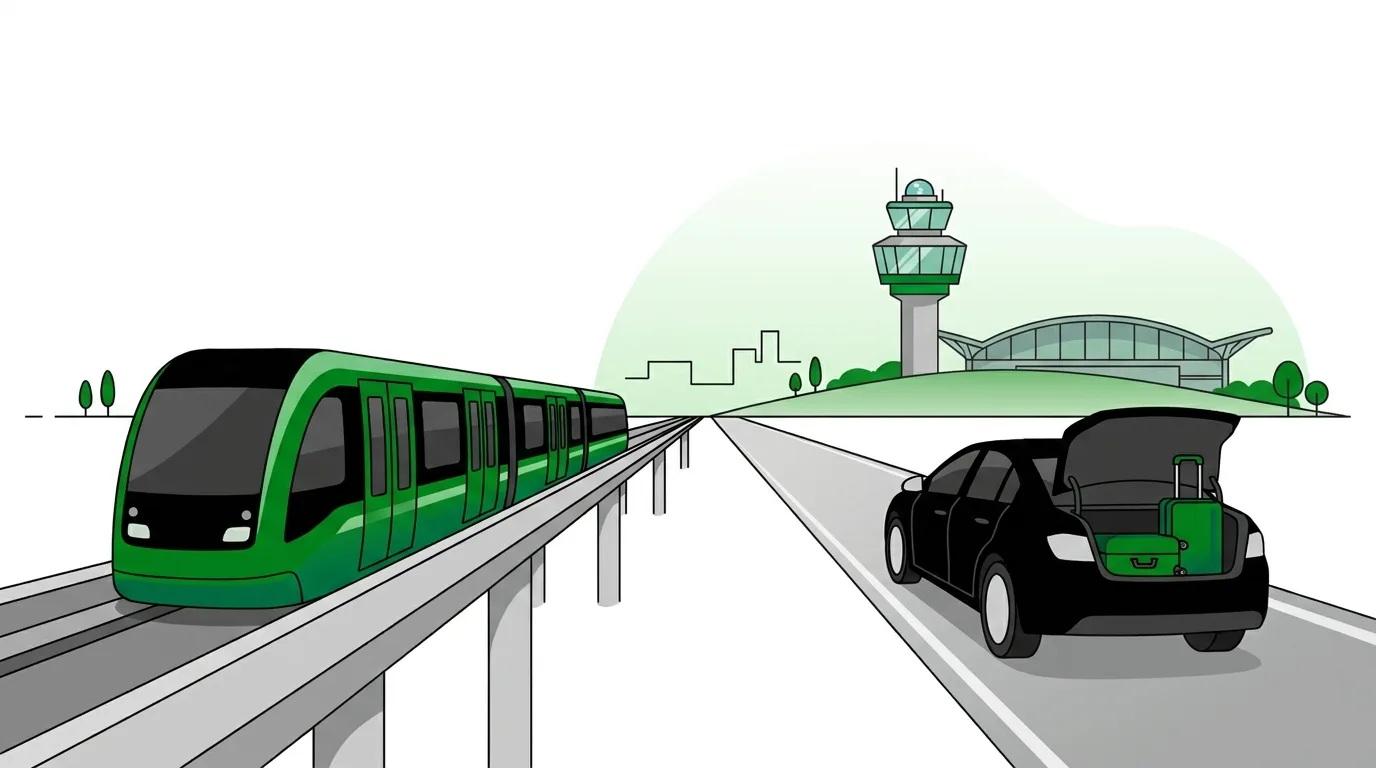
Every weekday morning across the Greater Toronto Area, thousands of people sit in Highway 401 traffic with empty vehicle seats. Offering those open seats to coworkers or classmates is a straightforward way to lower travel expenses when you follow how non-commercial carpooling works in Ontario.
When you share a commute solely to divide the costs of a trip you are already making, you operate a non-commercial carpool rather than a commercial transit service.
The core difference comes down to who controls the route and why the trip happens. On FellaRide, a Host is a vehicle owner who offers empty seats to community members for shared travel expenses without seeking profit, while a Guest is a rider who books a seat and shares those operating costs.
In commercial ride-hailing or taxi services, the customer directs the destination on demand so the operator can earn income.
- Shared origin and destination: Both the Host and Guests travel between a common starting area and destination as part of the Host's planned personal trip.
- Standard licensing: Because the trip is non-commercial, the Host operates under a standard Ontario Class G licence rather than a commercial permit.
Non-commercial carpooling shares an existing personal trip at cost, whereas commercial ride-hailing runs on-demand routes for profit.
| Factor | Non-Commercial Carpool | Commercial Ride-Hailing |
|---|---|---|
| Host Intent | Personal trip to work or campus | Generating income from fares |
| Route Control | Fixed by Host's existing schedule | Chosen on demand by customer |
| Payment Rule | Splitting actual operating expenses | Commercial rate including profit |
| Trip Frequency | One daily round-trip commute | Continuous shifts of on-demand trips |
| Licence Class | Standard Class G licence | Municipal commercial permit required |
Navigating GTA, Durham, and Halton Commuter Corridors and HOV Lanes
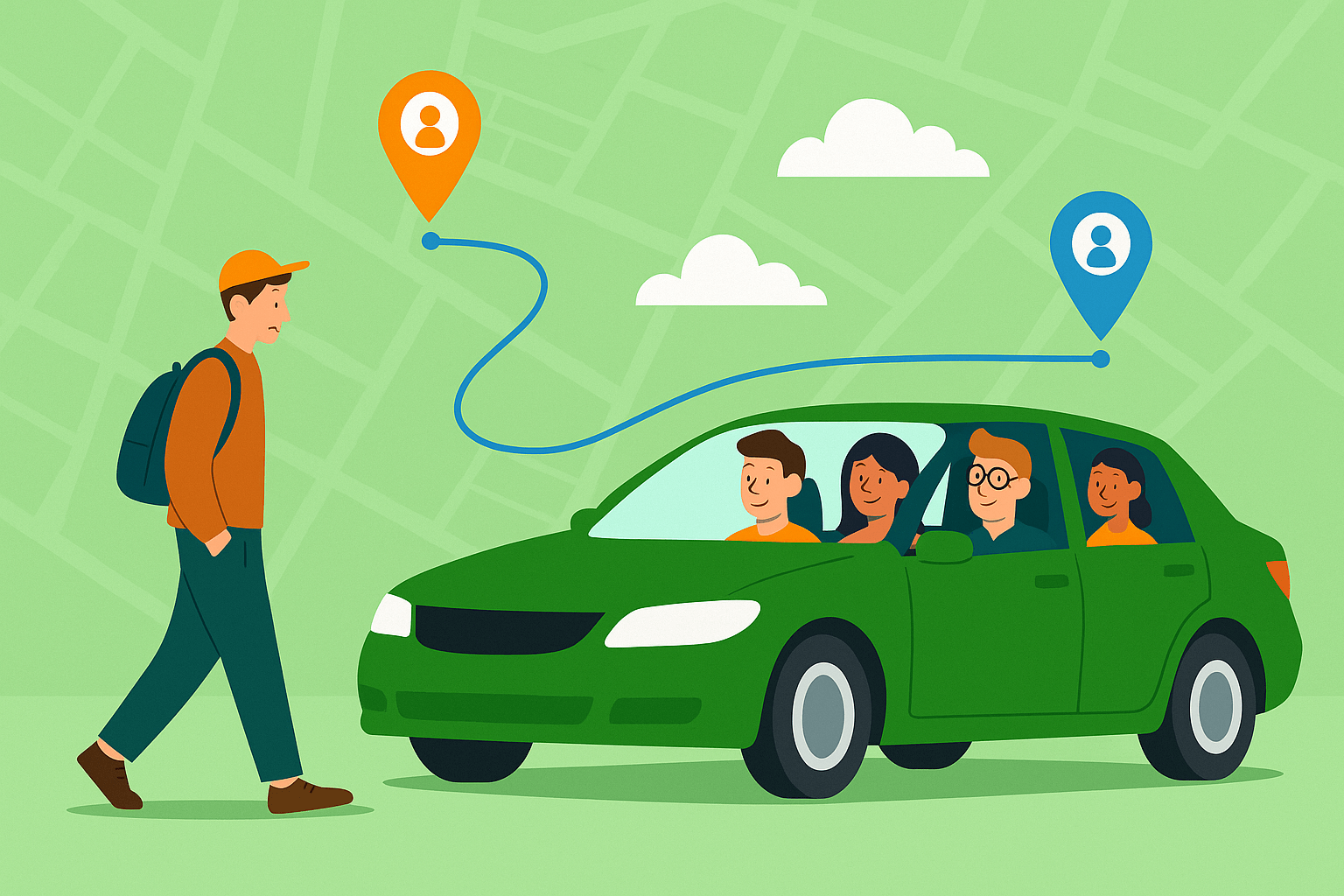
Most workplaces and campuses across the Greater Toronto Area, from Mississauga to Scarborough, are not directly linked by regional transit. Commuters moving across Halton, Peel, York, or Durham often face a bus, a subway transfer, and a long walk in the dark, or late-night shifts when local surface routes stop running. Community-based carpooling bridges this last-mile gap because your Host is already driving your regional corridor.
Beyond splitting gas and parking costs, travelling together unlocks dedicated highway infrastructure across Ontario.
Provincial police enforce strict entry and occupancy rules on 400-series HOV lanes:
- Solid buffer markings: Never weave across solid double lines or striped buffer zones separating HOV traffic from general lanes.
- Broken-line merge zones: Enter and exit the HOV lane only where broken white lines mark an official access point.
- Regional lot handoffs: Meet your carpool group at commuter lots near rapid transit or highway interchanges so nobody has to detour down quiet residential streets.
Tip: Agree on your exact highway rest stop and cost-splitting formula for fuel and 407 ETR tolls before leaving the GTA so everyone knows the plan.
Intercity Shared Rides to Niagara, Western Ontario, Kingston, and Ottawa
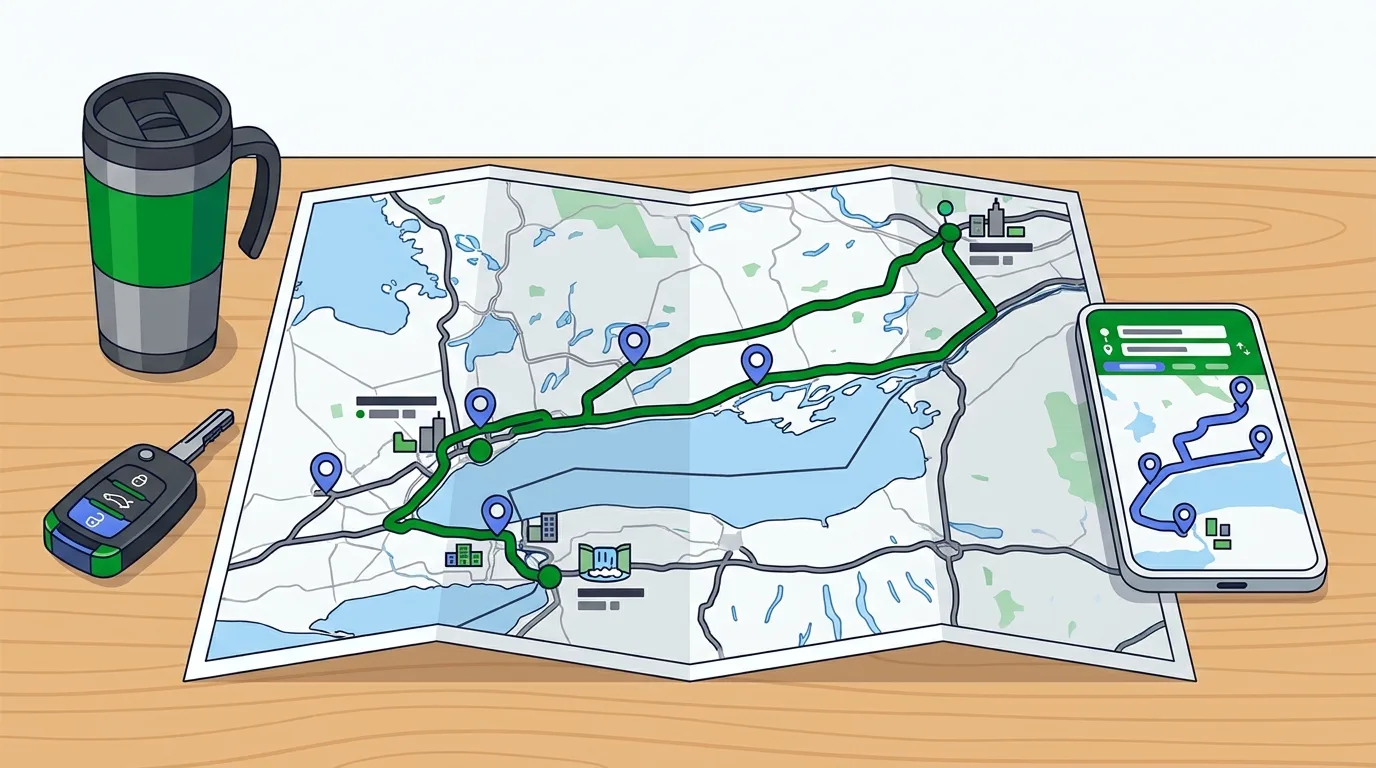
Carpooling is just as practical for weekend trips to Niagara or Blue Mountain and intercity travel across Southern and Eastern Ontario as it is for weekday work runs. When you plan a Toronto to Ottawa road trip with fellow students or regular commuters on FellaRide, everyone leaves from the same pickup point and arrives together without juggling separate train or bus tickets.
Most intercity groups heading east from the GTA leave in the morning early enough to clear the core before traffic backs up on the Don Valley Parkway or the Highway 401 collector lanes. Once your car passes Scarborough, Pickering, and Oshawa, urban congestion gives way to a steady highway rhythm.
For commuters and university students crossing eastern Ontario, scheduling a predictable 15-minute rest break near the midpoint keeps the Host alert and gives Guests time for washrooms and coffee. Agreeing on your highway stop before leaving the GTA avoids last-minute confusion at exit ramps.
As your carpool turns north onto Highway 416 and merges into Highway 417 (the Queensway), traffic moves at a calmer pace past green space, the Rideau Canal, and the parliamentary area.
Five highway towns along Highways 401 and 7 provide reliable rest and pickup hubs between Toronto, Kingston, and Ottawa.
| Rest Town | Route | Travel Stage | Carpool Benefit |
|---|---|---|---|
| Port Hope | Hwy 401 | About 1 hr east of GTA | Easy ramp access for morning coffee past Oshawa |
| Belleville / Napanee | Hwy 401 | Roughly 2 hrs from Toronto | Fuel stations, EV charging, and quick meals |
| Kingston | Hwy 401 | Midpoint along Hwy 401 | Student pickups, food, and gas on Division St |
| Brockville | Hwy 401 | About 1 hr from Ottawa | Quick rest stop right before the Hwy 416 turnoff |
| Perth / Carleton Place | Hwy 7 | Final hour into Ottawa | Historic downtown cafes before reaching west Ottawa |
Splitting Trip Costs, Tolls, and Auto Insurance Rules for Hosts and Guests
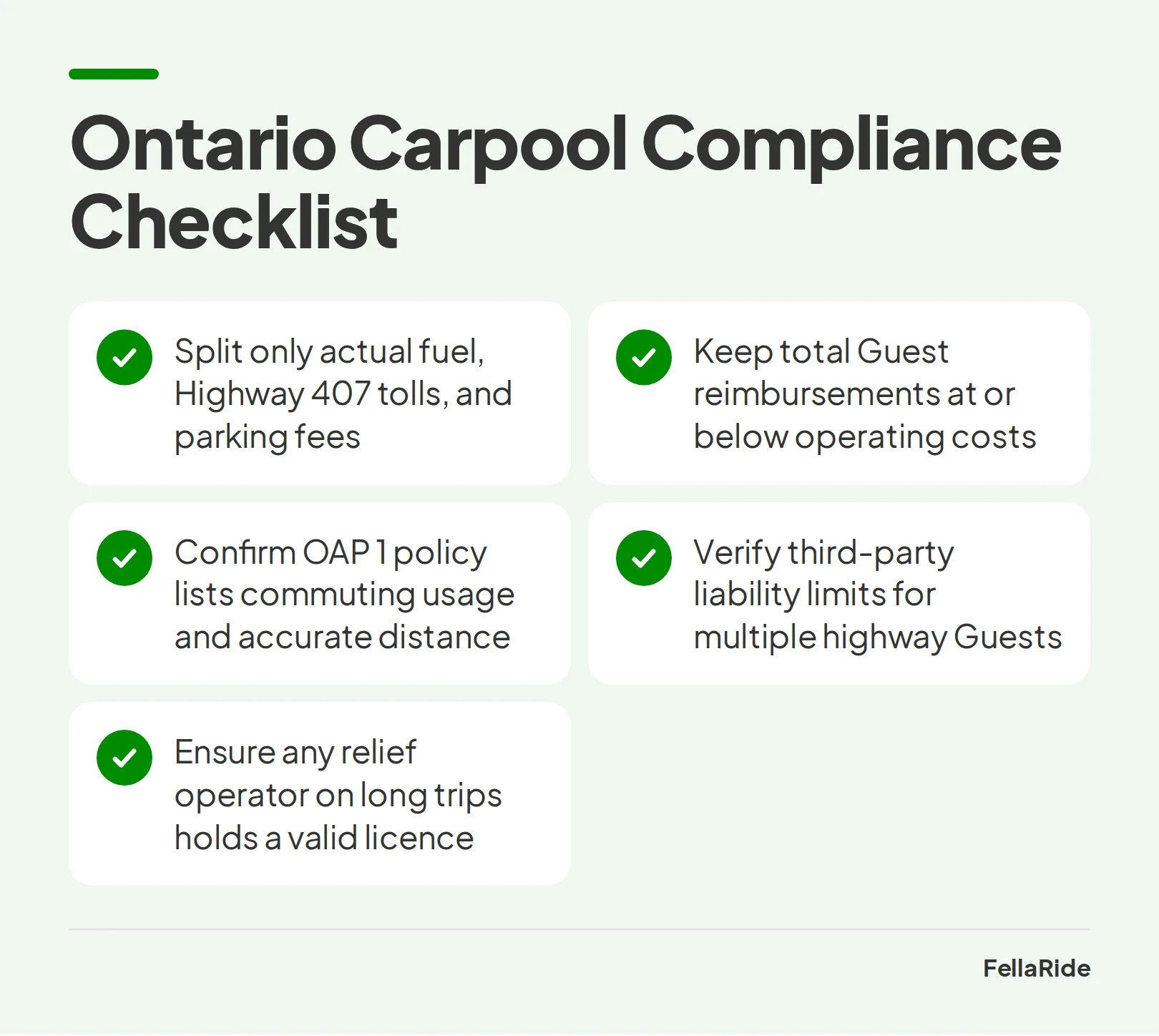
Under Ontario's non-commercial carpooling framework, Hosts and Guests can legally split fuel, Highway 407 ETR tolls, parking charges, and reasonable vehicle wear and tear as long as the Host makes no profit. Agreeing on a simple cost-splitting formula before the trip begins keeps expectations clear so nobody has to negotiate money in the car.
A common question for anyone starting a campus or workplace carpool is whether taking expense-sharing Guests affects personal auto coverage. Under the OAP 1 framework, using a personal vehicle for a non-commercial carpool where Guests only reimburse shared expenses counts as personal or commuting use rather than commercial operation.
Before you start carrying regular Guests, review three details on your policy with your insurance broker:
- Vehicle usage class: Confirm your policy lists the vehicle for commuting to work or school rather than pleasure only, and reflects your daily mileage.
- Third-party liability coverage: Check that your liability limit is sufficient for carrying multiple Guests along busy provincial highways.
- Vehicle rotation rules: When coworkers alternate taking their own vehicles on different days, each owner's individual policy covers their own car on the road.
Watch out: If a Guest ever takes a turn behind the wheel of your vehicle during a long highway drive, they must hold a valid Ontario licence and have your explicit permission, because your vehicle's insurance policy follows the car first if a collision occurs.
How Campus Trusted Groups Help Ontario Students Share Rides
For international and commuter students attending institutions like Seneca, Humber, York University, the University of Toronto, Sheridan College, or TMU, winter transit across the GTA is often exhausting and expensive. Waiting 15–20 minutes at an exposed bus stop on Yonge Street or Hurontario Street in freezing rain drains your focus before lecture even starts.
Comparing options in a GTA university commuter guide shows how matching with a peer who travels your corridor replaces cold transfers with a direct ride.
Instead of posting on an unmoderated public board, students can explore FellaRide's Trusted Communities Hub to join campus-specific Trusted Groups. FellaRide supports four community structures so members know who they are riding with:
- Organizational (ORG): Restricted to members who verify an authorized campus or corporate email domain.
- Moderator-Controlled (MOD): Requires explicit administrative review and approval before a user can join.
- Global (Open): Open communities that commuters can join without domain validation or moderator approval.
- Interest Based Communities: Groups organized around shared hobbies, sports, or activities without domain rules.
Riding in a warm car for thirty minutes with three classmates from your neighborhood also builds a supportive campus micro-community:
- Practical local guidance: Upper-year students share advice on winter boots, course registration, and fair rental housing.
- Work and internship referrals: Travelling with peers from other faculties opens up word-of-mouth leads for campus and part-time jobs.
- Shared cultural comfort: Playing familiar music and speaking languages from home eases isolation during a student's first Canadian winter.
- Morning schedule accountability: A regular carpool group gives everyone a friendly reason to leave on time for early lectures.
Building Workplace Carpool Programs and Organizational Mobility
At suburban office parks in Mississauga, Markham, Vaughan, Meadowvale, or near Pearson Airport and Highway 7, surface parking lots frequently fill up on mid-week in-office days. Learning how to launch an employee carpool program in the GTA helps facilities and HR teams cut single-occupancy vehicle congestion without leasing costly overflow lots.
When colleagues pair up along Highways 401, 404, or the QEW inside an Organizational (ORG) Trusted Group verified by company email domain, they bypass gridlock in HOV lanes and arrive with less highway stress.
Employees stick with workplace carpooling when the company sets a transparent cost-sharing rule for fuel and 407 ETR tolls and pairs it with visible daily rewards. Reserved front-row parking stalls by the building entrance cost almost nothing beyond signage, yet they motivate winter participation better than almost any other perk.
Low-cost employer incentives like front-row parking and flexible arrival windows support employee carpool participation and Scope 3 commute.
| Program Area | Employee Perk | Employer Requirement | Cost Level |
|---|---|---|---|
| Prime Parking | Front-row reserved stall | Stall signs and morning check | Low |
| Fuel or Toll Credit | Monthly gas or 407 ETR card | Automated trip log review | Medium |
| Flex Arrival Window | 15–30 min pickup grace period | Manager schedule alignment | None |
| Commuter Draws | Monthly raffle and Scope 3 log | Monthly trip report export | Low |
How to Set Up Your FellaRide Profile and Coordinate Your Commute
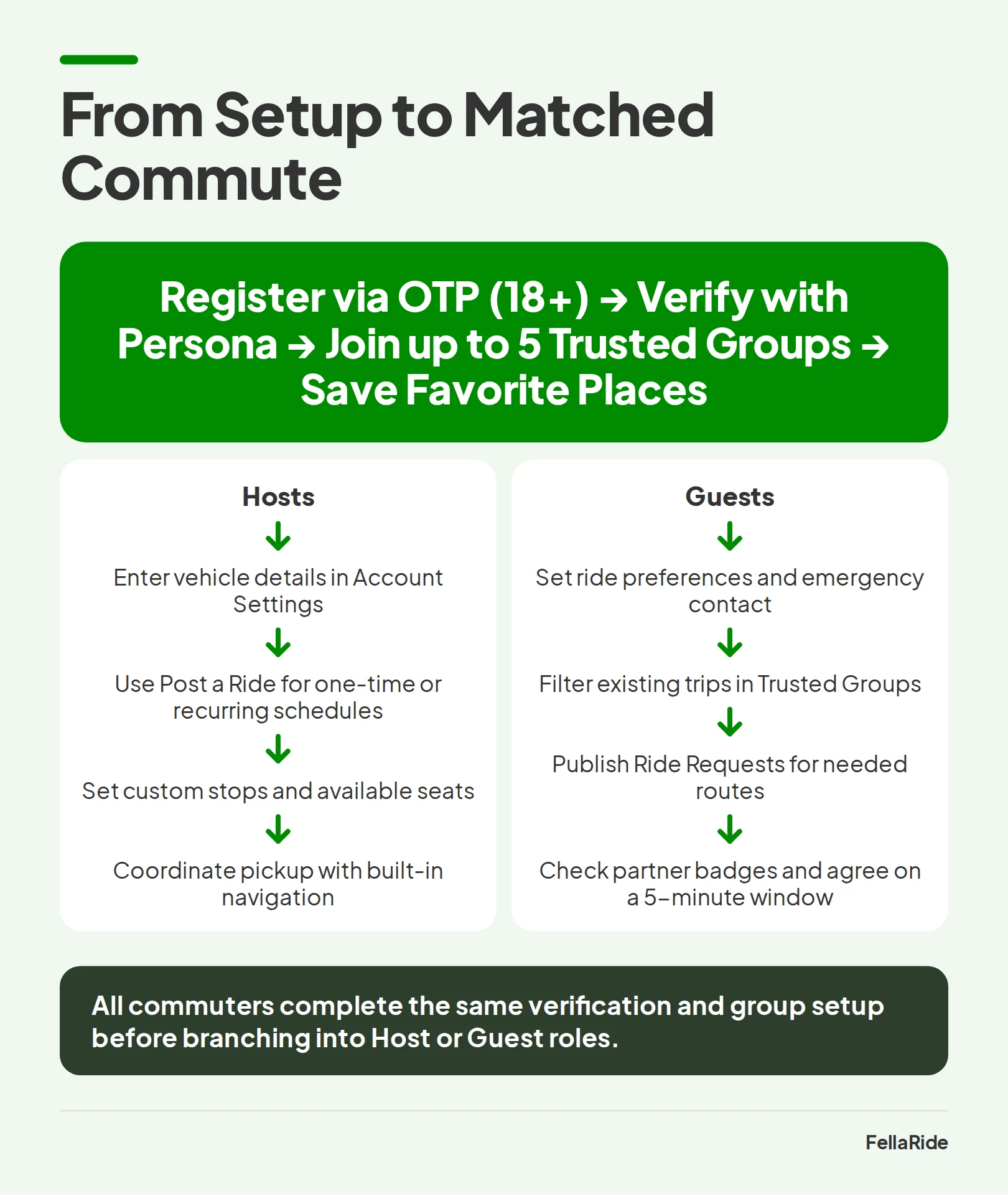
Setting up your account and scheduling recurring multi-day commutes on FellaRide takes only a few minutes. Follow these four steps to verify your profile and join your regional groups:
- Register your account: Install the FellaRide app on iOS or Android, enter your name, email, and phone number, and verify with a one-time passcode (OTP); users must be 18 or older.
- Complete Persona verification: Submit a government ID and selfie through Persona for optional identity and liveness checks to earn a profile trust badge; FellaRide stores only your verification status and expiry dates, never your ID documents.
- Join up to 5 Trusted Groups: Select up to 5 communities that match your campus, workplace, or highway corridor; FellaRide caps group counts and membership sizes to keep matching relevant.
- Save Favorite Places and vehicle details: Add home or campus locations as Favorite Places to speed up route searches, and enter your emergency contact, ride preferences, and vehicle details under Account Settings.
Once you are inside your communities, Hosts can use Post a Ride to publish one-time or recurring schedules with custom stops and available seats, while Guests can filter existing trips or publish Ride Requests. The app includes built-in navigation and route mapping tools to assist with trip coordination, along with In-App Dispute Reporting to report safety concerns or policy violations directly to support.
Keep your weekly carpool running smoothly by agreeing on a few ground rules before day one:
- Check profiles in advance: Review your carpool partner's community badges and exchange phone numbers before your first morning pickup.
- Set a 5-minute pickup window: Agree to wait up to five minutes past the scheduled departure time so one delay does not make the whole car late.
- Share schedule changes the night before: Message your Host or Guests the evening prior if you plan to work from home, stay late, or take a sick day.
- Align on cabin comfort and winter prep: Discuss temperature, audio volume, and coffee rules early, and ensure the Host keeps winter tires fitted, washer fluid topped up, and windows cleared of snow and ice.
Learn more about FellaRide
FAQ
Do I need a commercial permit or special taxi insurance to carpool in Ontario?
No, a standard Ontario Class G licence and personal Ontario Automobile Policy (OAP 1) cover non-commercial carpooling when you only recover actual trip costs on a commute you are already taking. Just confirm with your insurance provider that your vehicle usage class includes commuting to work or school and that your third-party liability limit is adequate.
How does FellaRide verify users and keep Campus or Workplace Trusted Groups secure?
Every FellaRide user must be at least 18 years old and confirm their account with a one-time passcode (OTP), and can complete optional identity and liveness checks through Persona or verify an Organizational (ORG) email domain to earn profile badges. FellaRide stores only your Persona verification status and expiry dates rather than your ID documents, and caps each user at a maximum of 5 Trusted Groups.
What happens if no Host has posted a ride along my Ontario commute corridor yet?
If you do not see an existing trip when you search and filter by route, date, and community, you can publish a Ride Request inside your Trusted Group. Both Hosts and other Guests in your community can view your request to coordinate a new shared route.
Can we use FellaRide for both weekday office commutes and intercity trips to Kingston or Ottawa?
Yes, FellaRide supports both one-time intercity trips and recurring multi-day commute schedules across your Trusted Groups. You can save Favorite Places like your home, office, or university campus to post or search daily GTA routes and weekend drives to Kingston, Ottawa, or Niagara.
Sources
- How Non-Commercial Carpooling Works in Ontario
- Toronto to Ottawa Road Trip: Best Way to Carpool Together
Learn more about FellaRide