Toronto to Ottawa Road Trip: Best Way to Carpool Together
Starting the Journey Across the Greater Toronto Area
There is something rewarding about a road trip that connects two major Ontario cities. A drive from Toronto to Ottawa feels manageable to plan, yet it offers plenty of ways to make the hours count. For commuters, university students, and regular visitors moving between the Greater Toronto Area and eastern Ontario, the route becomes shared time that helps everyone settle in before reaching the capital.
Most trips from Toronto to Ottawa begin in the morning: not at dawn, but early enough to clear the core before congestion builds on the Don Valley Parkway or the collector lanes of Highway 401. Once your group merges past the eastern suburbs of Scarborough, Pickering, and Oshawa, city noise fades quickly and the highway opens into a steady rhythm.
When you travel with others who make this intercity trip often, the first hour sets the tone for the whole drive. Choosing a clear pickup point near rapid transit keeps the morning departure simple and prevents long detours through residential streets.
Practical GTA Pickup Points for Eastbound Carpools
- Don Mills Station (Fairview Mall): Located right off Highway 401 and the Don Valley Parkway, with direct TTC Line 4 subway access and easy passenger loading zones.
- Scarborough Town Centre: Easily reached by transit and situated just south of the Highway 401 McCowan Road interchange for a quick eastbound merge.
- Yorkdale or Wilson Station: Ideal for groups starting in north or west Toronto who want to meet right along the subway line next to the highway.
- Oshawa GO Station: A convenient eastern meeting spot for riders coming from Durham Region who want to join the carpool without backtracking into Toronto.
Tip: Ask every passenger to arrive ten minutes before your planned departure time so you can load bags into the trunk and adjust seats before merging onto Highway 401.
Choosing Your Route: Highway 401 and 416 vs. Highway 7
Drivers heading from the Greater Toronto Area to Ottawa have two main routes across eastern Ontario. Both cover roughly 400 to 450 kilometres depending on your starting neighbourhood and final drop-off point, and each brings a distinct driving rhythm.
The primary expressway corridor follows Highway 401 east along Lake Ontario and the St. Lawrence River before turning north onto Highway 416 near Johnstown or Prescott. Because both highways are divided multi-lane roads with predictable service centres, this route is the standard choice for winter driving, evening trips, and groups who want steady highway speeds.
The alternative route branches off at Highway 115 or Highway 35 north of Bowmanville and follows Trans-Canada Highway 7 through Peterborough, Madoc, Tweed, Sharbot Lake, Perth, and Carleton Place. Mostly a two-lane highway winding through Canadian Shield rock cuts, lakes, and small historic towns, Highway 7 is slightly shorter in distance and offers local bakeries and lakeside parks for groups who prefer a calmer daytime drive.
How to Pick the Right Corridor for Your Group
- Take Highway 401 to Highway 416: Best when driving after dark, navigating winter weather, or picking up passengers in Kingston, Belleville, or Brockville.
- Take Highway 115 to Highway 7: Best during clear daylight hours when your group starts in northeast Toronto or Durham Region and prefers small-town stops.
- Check live conditions before leaving: Review the Ontario 511 traveller information map for current construction zones, lane closures, and winter road reports across both corridors.
What the Drive Feels Like and Where to Pause Along the Way
The drive between Toronto and Ottawa is straightforward, yet it never feels dull when shared with good company. Long stretches of highway are balanced by historic towns, limestone architecture, and rural greenery that give your carpool a natural reason to pause and stretch.
These mid-trip breaks are where road trip moments happen naturally. Someone suggests stopping for coffee, another passenger points out a familiar river crossing, and playlists rotate around the cabin. Even quiet stretches feel comfortable because everyone in the vehicle is moving in the same direction.
For commuters and students who travel this corridor often, building a predictable fifteen-minute break near the halfway mark keeps the driver fresh and gives everyone time for washrooms and snacks. The table below compares five reliable towns across both routes where a shared ride can pull off and regroup.
Choosing your rest stop before you leave the GTA prevents last-minute confusion near highway exits. Once everyone stretches their legs and grabs a drink, the second half of the drive into the Ottawa Valley passes quickly.
| Stop town | Highway corridor | Approximate point | Why it works for carpools |
|---|---|---|---|
| Port Hope | Highway 401 | 1 hour east of Toronto | Quick highway access for an early coffee after clearing GTA traffic |
| Belleville / Napanee | Highway 401 | 2 hours east of Toronto | Cluster of gas stations, fast casual food, and EV chargers near exits |
| Kingston | Highway 401 | Halfway on the 401 corridor | Major transit hub for student pickups, dining, and fuel along Division Street |
| Brockville | Highway 401 | 1 hour before Ottawa | Convenient pause just before turning north onto Highway 416 |
| Perth / Carleton Place | Highway 7 | Last hour on Highway 7 | Walkable heritage streets and local cafes before entering west Ottawa |
Why Ottawa Feels Like a Natural Arrival
Arriving in Ottawa feels noticeably calmer than pulling into a dense financial district. As you follow Highway 416 north into Highway 417 (the Queensway), the streets widen, traffic flows at a measured pace, and green space frames the approach into the city.
Passing landmarks like the Rideau Canal National Historic Site and the parliamentary precinct signals that you have reached the capital without feeling overwhelmed. For people regularly travelling from Toronto to Ottawa, the city is walkable, organised, and easy to navigate together.
Just as in the GTA, choosing a clear drop-off spot along Ottawa's O-Train light rail line or near major campuses helps every passenger complete the last leg of their journey smoothly.
Convenient Ottawa Drop-Off Hubs
- Bayshore Shopping Centre / Station: Located right off Highway 417 in the west end, making it the fastest first stop for passengers heading to west Ottawa or Kanata.
- Carleton University or uOttawa Campus: Central drop-off spots for students returning for the semester or visiting friends over a long weekend.
- Rideau Centre / Downtown Core: Walkable to the ByWard Market, Parliament Hill, and O-Train Line 1 for commuters staying downtown.
- St. Laurent or Blair Station: Ideal eastern transit hubs with direct highway ramps so the driver does not have to navigate narrow downtown streets.
The Challenge of Travelling Together Regularly
Travelling together sounds simple in theory, yet people who regularly move between Toronto and Ottawa often run into small logistical hurdles. Passengers start from different suburbs across the GTA, carry different amounts of luggage, and hold different expectations around departure times and rest stops.
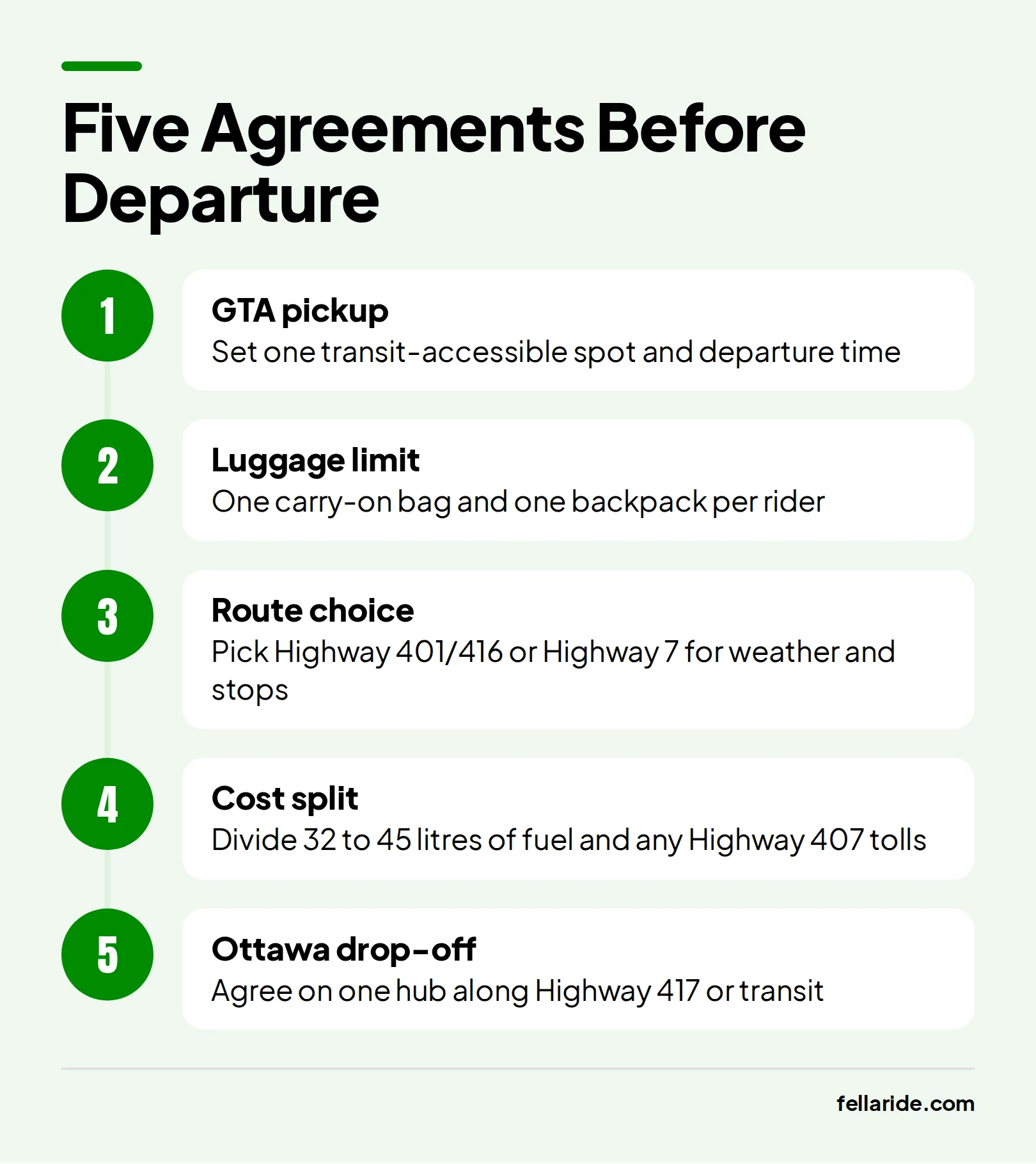
When transport coordination relies on scattered group chats, small mismatches in timing, fuel splitting, or comfort levels can add pressure to what should be a routine journey. Agreeing on five practical details before departure day keeps everyone aligned from pickup to arrival.
How to Split Trip Costs Fairly
- Estimate fuel before departure: A 450-kilometre drive uses roughly 32 to 45 litres of gas depending on the vehicle, so sharing fuel costs across three or four riders keeps per-person expenses predictable.
- Account for Highway 407 ETR tolls if used: If the group agrees to bypass northern GTA congestion on Highway 407, decide upfront whether the toll fee is split equally among everyone.
- Keep luggage limits clear: Four adults in a compact sedan cannot each bring two large suitcases, so confirm one carry-on sized bag and a backpack per rider ahead of time.
Watch out: Winter squalls off Lake Ontario near Cobourg, Kingston, and Brockville can slow traffic quickly, so pack washer fluid, warm layers, and a snow brush from November through April.
How FellaRide Makes Regular Travel Between Toronto and Ottawa Simpler
For people regularly travelling between Ottawa and Toronto, FellaRide makes it easier for everyone to start the journey on the same route. Instead of managing multiple cars, different tickets, or complicated plans, a shared ride keeps things simple and organised.
Travelling together in one vehicle changes the entire experience. Everyone starts at the same time and arrives together, so there is no waiting around or worrying about separate delays. You can see how riders coordinate trip details by exploring the FellaRide in-app experience before your next intercity drive.
Sharing the journey also helps passengers who are not fully familiar with eastern Ontario highways. Being in a car with others who know the route makes the drive feel safer and less stressful, especially if you connect through local FellaRide carpool communities of fellow students and regular commuters.
Why Shared Rides Work So Well on This Corridor
- Shared travel costs: Splitting fuel and travel expenses makes frequent trips between Toronto and Ottawa much more affordable.
- Fewer cars on the highway: Combining multiple travellers into one vehicle is a more sustainable way to move between cities.
- Built-in road trip connection: Shared laughs over a missed exit, group decisions to stop for snacks, and relaxed conversations turn travel time into useful shared time.
Start Your Next Toronto to Ottawa Carpool Together
A Toronto to Ottawa road trip works so well because the distance is manageable, the highways are reliable, and the route quickly becomes familiar. When you travel with others heading the same way, the hours on the road build comfort and connection instead of fatigue.
Choosing shared travel options like FellaRide adds comfort and simplicity to the journey, helping people start together, travel together, and arrive together. FellaRide is available on mobile, and you can visit the FellaRide home page to get started on your phone and plan your next shared trip between Toronto and Ottawa.