McMaster Student Carpooling: Rides to Hamilton & the GTA
TL;DR
- Sharing a ride with at least two occupants unlocks HOV lanes on Highway 403 and the QEW between the GTA and Hamilton.
- Splitting fuel and Main Street West parking costs follows Ontario's non-commercial carpooling rules when the Host recovers expenses without profit.
- FellaRide recommends a $5 minimum contribution per trip and a $0.20/km guideline to help a Host offset operating expenses.
- Students aged 18 and older can verify their identity through Persona and join up to 5 Trusted Groups matching their campus and corridor.
Join a Trusted Campus Commuter Group
Connect with verified Hosts and Guests traveling between the GTA and Hamilton to split fuel and parking costs with no commercial markup.
What you need
Commuting between the Greater Toronto Area and McMaster University in Westdale requires careful coordination before the semester begins. Gathering a few basic details ahead of time makes it easier to match schedules, share costs fairly, and clear morning bottlenecks along the western shore of Lake Ontario.
- Your weekly academic calendar: Write down exact start and finish times for your lectures, labs, tutorials, and part-time jobs across the week.
- A verified FellaRide profile: Individuals aged 18 or older can install the FellaRide app on iOS or Android and register with a one-time passcode.
- Government photo ID: Useful for completing optional third-party verification through Persona to earn a profile trust badge.
- A backup PRESTO card: Keeping a loaded transit card ensures you have a fallback option on days when evening lab times shift unexpectedly.
- Low-detour meeting landmarks: Identify convenient highway interchanges, GO stations, or main intersections near your home and Main Street West.
1. Navigating the McMaster Student Carpool Corridor Along Highway 403 and the QEW
An early morning seminar at McMaster University looks very different depending on whether you start your commute in Brampton, Mississauga, Oakville, or Burlington. Auditing your weekly schedule leg by leg helps you see where regional highway corridors outperform multi-transfer transit trips. Many post-secondary commuters travel during shoulder hours when suburban feeder buses run infrequently.
Highway 403 and the Queen Elizabeth Way (QEW) form the primary artery into west Hamilton.
Using these dedicated lanes across Peel and Halton lets shared vehicles bypass single-occupant traffic jams before descending the Niagara Escarpment toward the Main Street West exit. Keep these essential provincial rules and corridor planning steps in mind:
- Verify your occupancy count: Confirm at least two people are inside the vehicle before entering the lane, unless the car displays valid green licence plates or an eligible provincial permit.
- Respect striped buffer zones: Never cross the solid double lines or striped pavement markings separating the HOV lane from general traffic.
- Use broken-line merge zones: Enter and exit the HOV corridor only where dashed white lines mark an official access point.
- Meet at highway carpool lots: Use provincial carpool parking lots located directly beside major highway interchanges to leave a second car safely parked and consolidate into one vehicle.
- Time the Main Street West exit: Plan your transition out of the left lane well ahead of the Highway 6 junction and the Main Street West exit into Westdale.
Reviewing our Ontario regional carpool corridor guide can help you map out convenient highway meeting points between the western GTA and Hamilton. Saving your frequent campus buildings and interchange hubs as Favorite Places in the app makes posting or searching daily routes much faster.
Tip: Confirm your exact pickup landmark, five-minute waiting window, and fuel or parking split in the in-app chat the evening before your first Monday morning drive.
2. Comparing GO Bus Routes, Solo Driving, and Campus Carpooling to Hamilton
Even with discounted base fares, crossing multiple municipal boundaries on regional buses can create hidden financial and scheduling strain.
When a feeder bus runs late or highway queues stall express coaches, students risk missing midterm exams or losing hours at a part-time retail or hospitality shift. Ordering a last-minute commercial taxi or ride-hail vehicle during rush hour triggers surge pricing that quickly drains a semester budget. You can explore our GTA university commuter comparison to see how transit and shared rides stack up across the region.
Solo driving gives you door-to-door schedule control, yet paying for all of your gas, vehicle upkeep, and Westdale or campus parking alone is expensive. Sharing empty seats in a vehicle already heading to Hamilton turns those fixed costs into a predictable, split contribution while opening up HOV lane speed advantages.
3. Splitting Main Street West Parking Permits and Fuel Under Ontario Rules
Whether your group parks in an outdoor campus lot near Lower Westdale or uses nearby commuter spaces off Main Street West, dividing permit fees and fuel among three or four people lowers everyone's monthly spend. Before collecting or sending contributions, both the Host and Guest should understand what keeps a shared ride non-commercial in Ontario.
Under our guide to how non-commercial carpooling works in Ontario, the boundary between peer cost-sharing and commercial transport rests on trip intent and expense recovery. In a valid carpool, the Host already has a personal reason to travel to Hamilton, such as attending lectures or working on campus. In commercial ride-hailing, the rider dictates the destination and the operator drives for profit.
FellaRide operates strictly as a technology marketplace for non-commercial cost recovery rather than a commercial carrier, and earning a profit is prohibited. Follow these four steps to structure your campus cost split within provincial rules:
- Share a common trip corridor: Ensure the Host and every Guest are traveling between a common starting area and a shared destination along the Host's planned route.
- Keep frequency incidental: Limit trips to your routine academic or work commute, typically a single round trip each day between home and campus.
- Follow cost-recovery guidelines: Reimburse only a fair portion of actual operating expenses.
- Maintain a standard Class G licence: Because no commercial profit is generated and cost recovery stays within provincial carpooling rules, the Host drives under a standard Ontario Class G licence rather than a municipal taxi permit.
4. How to Find Verified McMaster Peers in FellaRide Trusted Groups
Searching anonymous classified boards or unmoderated social media threads for a ride to Hamilton can feel risky when you cannot verify who is behind the account. Organizing rides inside closed or semi-private campus communities gives students and staff built-in accountability, aligned lecture schedules, and consistent pickup points.
On FellaRide, a Trusted Group connects members around a shared affiliation such as a university campus, workplace, neighborhood, or common interest. Communities fall into three access categories: Global (Open) groups anyone can join, Organizational (ORG) groups requiring an authorized email domain check, and Moderator-Controlled (MOD) groups where prospective members submit a request for approval.
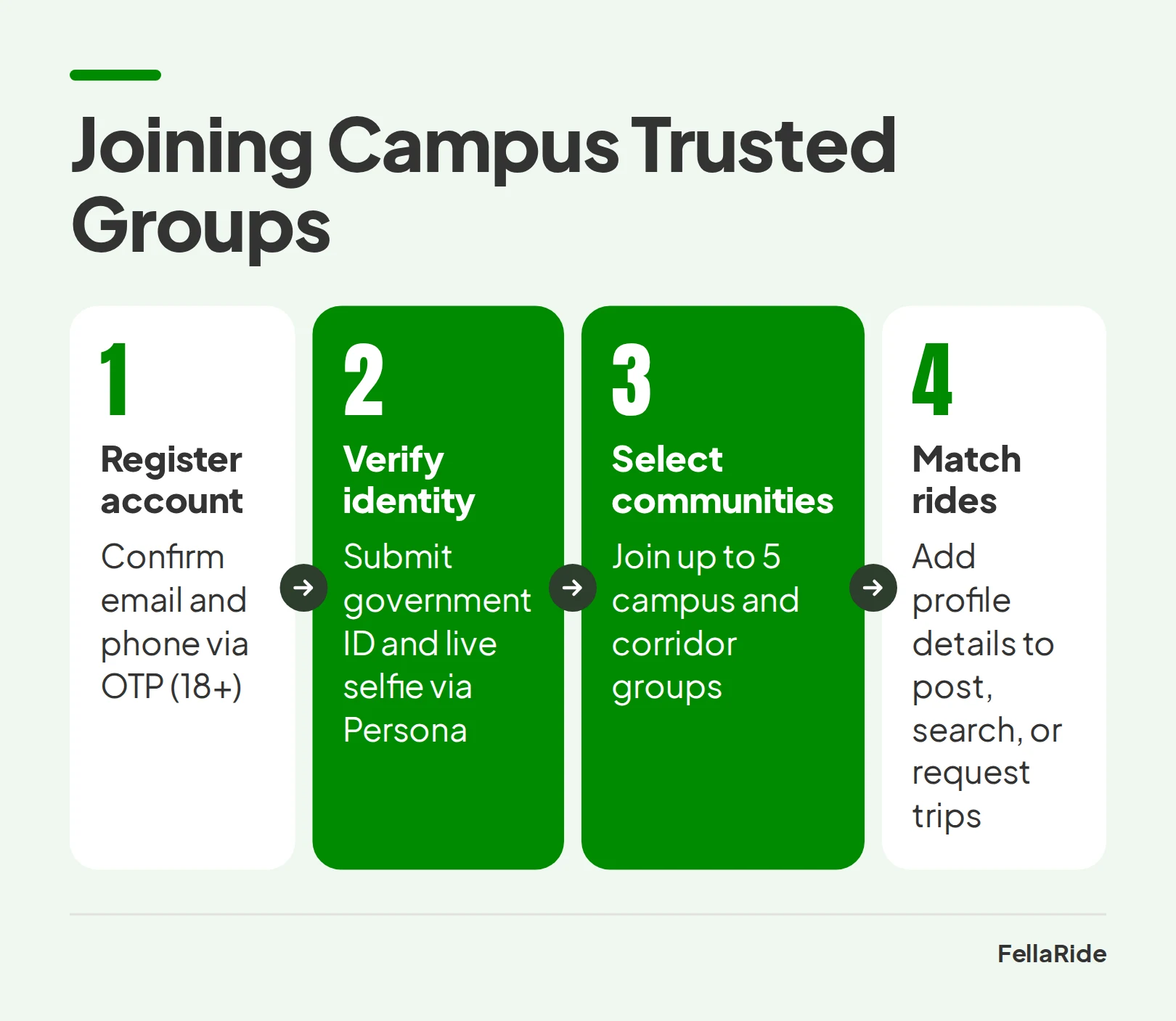
Follow these four steps to verify your profile and connect with peers heading toward Hamilton:
- Register with OTP verification: Download the FellaRide app on iOS or Android, enter your name, email address, and phone number, and confirm your account using a one-time passcode (OTP). You must be 18 or older to register.
- Complete Persona identity checks: Submit a government-issued ID and a live selfie through Persona, FellaRide's third-party verification provider. Rather than retaining copies of your ID documents, FellaRide records only your verification outcome and expiration dates, awarding a profile badge that builds community trust.
- Choose up to 5 communities strategically: FellaRide caps each user at a maximum of 5 communities and limits total members per group to keep match quality high. Work around this 5-group limit by selecting only the specific Trusted Groups that directly match your campus affiliation and your home highway corridor.
- Add vehicle details and post or search: Open Settings and select Account to enter your emergency contact, ride preferences, and vehicle information if you will act as a Host. You can then use Post a Ride to offer empty seats, Search a Ride to filter available trips, or post Ride Requests for fellow community members to match with.
Watch out: Never send upfront e-transfers to unverified posters on public social media pages before confirming their identity and route details inside a verified community.
5. Coordinating Daily Lectures, Hybrid Transit Transfers, and Weekend GTA Trips
You do not need to rely on a single transportation mode for all five days of the week. Because non-commercial carpooling depends on a Host's personal schedule and ride availability is not guaranteed, you can pair shared rides with public transit and keep a loaded PRESTO card in your wallet as a reliable backup whenever lecture times change unexpectedly.
Our GTA student carpooling guide walks through how students structure multi-day schedules across the semester.
FellaRide supports both one-time trips and recurring schedules, allowing a Host and a Guest to coordinate logistics directly through in-app chat. Consider these three ways to organize your weekly Hamilton travel:
- First-mile GO hub connections: Match with a neighborhood Host to reach a major regional hub such as Oakville GO, Kipling Station, or Highway 407 Station, skipping slow local feeder buses.
- Morning carpool, evening transit: Join a morning Host heading straight down Highway 403 to arrive rested for an 8:30 a.m. lab, then use your PRESTO card to ride a GO bus home at your own pace after late evening study sessions.
- Recurring weekday blocks and weekend trips: Lock in a recurring two-day or three-day morning ride group for core lectures, and post one-time rides on Friday afternoons when heading back toward Mississauga, Brampton, or Toronto for the weekend.
Consistent habits keep a multi-day carpool running smoothly from September through April. Following core carpool etiquette rules for shared commutes, such as arriving at your pickup corner five minutes early, storing heavy backpacks cleanly at your feet, and messaging immediately if you catch a cold, shows respect for everyone in the vehicle.
6. Preparing Your Hamilton to GTA Carpool for Winter Weather on the Escarpment
Waiting 15–20 minutes at an exposed suburban stop in January drains your focus before you ever reach lecture.
Winter squalls off Lake Ontario and sudden icing along the Highway 403 Escarpment hill require a clear plan before November flurries arrive. Lock in these five winter protocols with your carpool group:
- Equip the vehicle for highway slush: Ensure the Host vehicle has dedicated winter tires, fresh wiper blades, low-temperature washer fluid, and an emergency trunk kit stocked for highway standstills.
- Set snow-day check-in cut-offs: Agree on an evening-before and early-morning message deadline in the in-app chat in case McMaster cancels morning classes or moves a seminar online.
- Use plowed arterial pickup corners: Pick backup meeting spots on main plowed roads rather than unplowed residential crescents when heavy snow falls overnight.
- Build in a departure buffer: Establish preset backup departure windows on yellow or red weather mornings so no Guest is left waiting on an icy sidewalk.
- Turn travel time into community support: Sharing a warm cabin for thirty minutes lets upper-year and international students swap practical advice on winter gear, course registration, and campus job leads.
Learn more about FellaRide
FAQ
Do I need a commercial Host's licence to carpool to McMaster University?
No, a Host does not need a commercial permit when sharing a personal commute to campus with no profit margin. As long as you and your Guests share a common route on your normal daily schedule and only split actual vehicle operating costs, you can drive under a standard Ontario Class G licence.
How does FellaRide protect my privacy during Persona ID verification?
When you complete optional identity verification, you submit your government ID and a live selfie directly through Persona, a third-party verification provider. FellaRide does not store copies of your identification documents, keeping only your verification status and expiry dates to display a trust badge on your profile.
What should I do if a ride dispute or safety concern comes up?
FellaRide includes two-way review mechanisms and an in-app dispute reporting tool so members can maintain community standards. You can report safety concerns, ride disputes, or policy violations directly to support inside the application.
How many occupants are needed to use the Highway 403 and QEW HOV lanes?
Provincial High Occupancy Vehicle lanes on Highway 403 and the QEW require a minimum of two people in the car: one Host and at least one Guest. Vehicles displaying valid green licence plates or an eligible provincial permit may also use these lanes, provided they enter and exit only at broken white merge lines.
Sources
- Post-Secondary Student Discount
- Extreme cold - Canada.ca
Learn more about FellaRide