How to Launch an Employee Carpool Program in the GTA
Why GTA workplaces are turning to employee carpool programs
On a Tuesday morning at a suburban office park in Mississauga, Markham, or Vaughan, the surface parking lot often fills up before the first meeting starts. As hybrid teams coordinate their in-office days, mid-week congestion creates a real bottleneck for facilities and HR leaders.
Expanding a surface lot or leasing overflow stalls nearby is expensive and slow. A structured employee carpool program reduces single-occupancy vehicles on peak days while making the daily drive easier and more affordable for your team.
When two or three colleagues share a ride along the 401, QEW, or 404, they can use Ontario high occupancy vehicle (HOV) lanes to bypass gridlock. Employers also gain reliable commuter data for Scope 3 Category 7 employee commuting emissions under the Greenhouse Gas Protocol.
For suburban employment zones around Pearson Airport, Meadowvale, or Highway 7, transit connections often require multiple transfers across municipal boundaries. Pairing coworkers who already drive along the same highway corridor bridges that gap immediately without waiting for new infrastructure.
| Area | Employer benefit | Employee benefit |
|---|---|---|
| Parking | Lower stall demand | Front-row spots |
| Attendance | Steady office turnout | Less highway stress |
| Costs | No overflow leases | Split gas and tolls |
| Reporting | Scope 3 commute data | HOV lane access |
What you need
Before you announce a program or paint parking stalls, gather a few core inputs across HR, facilities, and operations. Having these ready keeps the rollout smooth and prevents policy gaps later.
- Anonymized postal code data: A list of employee home forward sortation areas (first three characters of the postal code) from HR records to map commuter clusters.
- Parking lot layout map: A current diagram of your surface lot or garage showing total stalls, accessible spaces, visitor spots, and main building entrances.
- Employee commute survey tool: A short form to capture current travel modes, preferred in-office days, and arrival and departure windows.
- Workplace carpool matching platform: A system that verifies work email addresses, pairs commuters along highway corridors, and logs shared arrivals.
- Incentive and safety-net budget: Approved funding for signage, optional fuel or transit perks, and emergency ride vouchers.
- Program coordinator time: A designated owner in HR or facilities to manage setup, signage, and launch communications.
1. Audit your current parking capacity and commuter corridors
Start by measuring how your parking lot actually performs across the workweek. Have facilities or security count occupied stalls on Tuesday, Wednesday, and Thursday mornings, and compare those totals against Monday and Friday occupancy.
Next, export the first three characters of employee home postal codes from your HR system so individual addresses remain private. Plot those clusters against your workplace location to see which Greater Toronto Area highways carry the bulk of your team.
Look for natural geographic funnels where routes overlap even if employees start in different towns. For example, commuters driving in from Burlington and Oakville share the QEW and 403 corridor, while staff in Whitby, Ajax, and Pickering converge along Highway 401 East.
Key data points to gather in your baseline survey
Send a quick commuter survey to confirm what the postal code map suggests. Keep it brief so employees complete it in a couple of minutes.
- Primary travel mode: Ask how they currently get to the office on most days.
- Typical schedule: Capture their usual arrival time, departure time, and hybrid anchor days.
- Route corridors: Identify whether they travel along the 401, 400, 404, DVP, QEW, 403, or 407 ETR.
- Meeting point preferences: Check if they prefer doorstep pickup or meeting at Ontario Ministry of Transportation carpool lots right off highway interchanges.
- Carpool role: Ask whether they are willing to drive, prefer to ride as a passenger, or want to alternate driving duties.
Tip: Look closely at employees who live along the same highway corridor and share the same department anchor days, as they form your easiest initial matches.
2. Define your workplace carpool policy and incentive structure
Employees stick with carpooling when the daily reward is obvious and the rules are fair. Your policy should clearly state what qualifies as a valid carpool, how cost-sharing works, and what perks participants earn.
In Ontario, true carpooling involves drivers and passengers sharing the genuine costs of a trip the driver was already taking, rather than operating for commercial profit. Spell out a simple, transparent formula for splitting fuel and 407 ETR tolls so coworkers never have to negotiate money awkwardly in the car.
Pair those guidelines with practical workplace perks. Reserved parking right by the front door costs the company almost nothing beyond signs, yet it is often the strongest motivator during a cold January morning.
Document your ground rules in a short one-page guide so drivers and passengers know what to expect before their first trip. Include clear policies on minimum vehicle occupancy, morning stall release times, and how pairs qualify for monthly perks.
| Incentive | Employee perk | Admin need | Cost level |
|---|---|---|---|
| Prime parking | Front-row stall | Signs and arrival check | Low |
| Fuel or toll credit | Monthly gas or 407 card | Automated trip log | Medium |
| Flex arrival window | 15–30 min pickup grace | Manager alignment | None |
| Prize draws | Monthly commuter raffle | Monthly trip report | Low |
3. Set up a verified company carpool network
Spreadsheets and open chat channels rarely sustain a workplace carpool program for long. Schedules shift, new hires join, and employees hesitate to post their home neighbourhoods and phone numbers on a static bulletin board.
Instead, establish a closed, verified company network where employees register using their corporate email domain or single sign-on credentials. Knowing that every profile belongs to a verified coworker or approved office-park neighbour builds immediate trust.
If your workplace shares a large business park with neighboring employers, you can also explore whether a multi-employer ring makes sense after your internal launch stabilizes. Starting inside your own organization first keeps communication clear and lets HR refine the rules with a familiar group.
Features to configure in your matching network
When setting up the network for your workplace, configure the matching rules to reflect how your people actually work and travel.
- Corridor-based matching: Match commuters whose routes overlap along major highways rather than only matching next-door neighbours.
- Shift and anchor-day filters: Let hybrid staff filter matches by specific days of the week or shift start times.
- Commuter preferences: Allow users to note quiet-ride preferences, music tastes, or whether they prefer meeting at a highway carpool lot.
- Privacy controls: Display approximate route overlap and neighbourhood zones instead of exact street addresses until a pair agrees to ride together.
4. Configure geofenced arrival tracking and reserved carpool parking
The fastest way to erode trust in a carpool program is allowing solo drivers to park in reserved carpool spots without consequence. At the same time, facilities teams do not want security guards standing in the lot checking paper hangtags every morning.
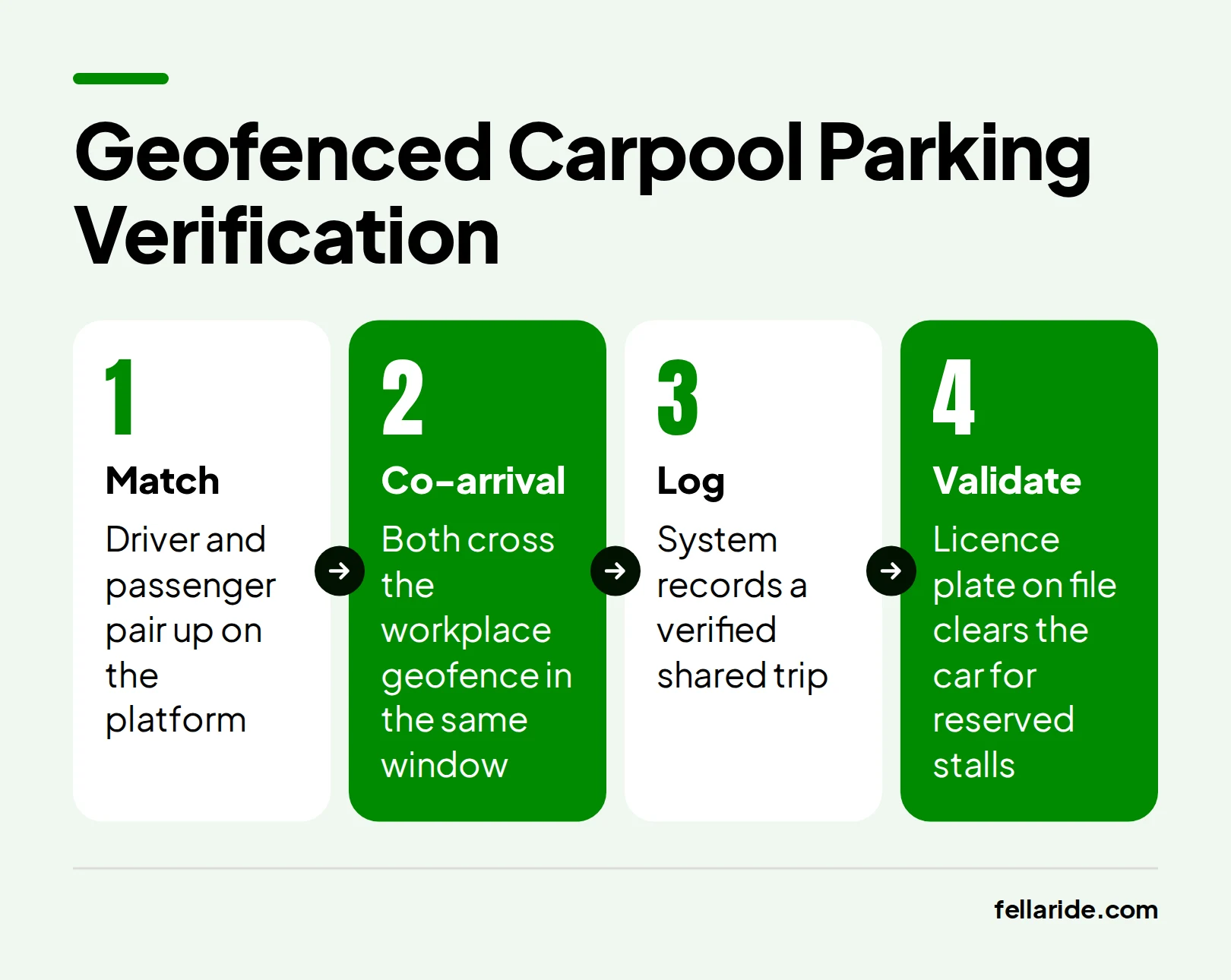
Geofenced arrival tracking solves this problem automatically. You define a virtual perimeter around your workplace parking lot and connect it to your carpool matching platform.
How to link geofencing with your parking stalls
- Select prime stalls: Convert a dedicated block of stalls closest to the main building entrance into reserved carpool spots.
- Post clear cutoff times: Put up signs stating the stalls are reserved for verified carpools until a set morning cutoff time, after which any employee may use unoccupied spots.
- Set the geofence boundary: Draw the virtual arrival zone around your property entrance and parking areas.
- Verify co-arrival: When a matched driver and passenger travel together and cross into the workplace geofence within the same arrival window, the system logs a verified shared trip.
- Validate parking eligibility: Tie the vehicle licence plate on file to the day's verified arrival list so facilities can confirm compliance in seconds.
Watch out: Keep the geofence tight enough that it covers your lot and immediate entrance roads without capturing public transit stops or adjacent highways where employees might pass by independently.
5. Establish a guaranteed ride home safety net
The biggest hesitation employees have about leaving their car at home is the fear of being stranded at the office. If a child gets sick at school, an urgent late afternoon meeting comes up, or the driver has to leave early, the passenger needs a reliable way home.
A Guaranteed Ride Home (GRH) policy removes that anxiety. When an unexpected emergency breaks up a confirmed carpool, the employer covers the passenger's trip home via rideshare, taxi, or regional transit such as GO Transit.
Rules for a clear Guaranteed Ride Home policy
Keep the rules straightforward so employees feel confident using the program without worrying about abuse. Most workplaces find that actual claims remain low once commuters know the safety net exists.
- Eligibility: Require a verified carpool arrival to the workplace on the day the emergency ride is requested.
- Covered situations: Include personal or family illness, unscheduled overtime requested by a manager, or a driver leaving unexpectedly.
- Annual cap: Set a clear annual limit on the number of emergency rides per employee so the budget stays predictable.
- Simple reimbursement: Issue pre-approved rideshare vouchers through HR or reimburse receipts on the next expense cycle.
6. Launch the program to employees and track return-to-office impact
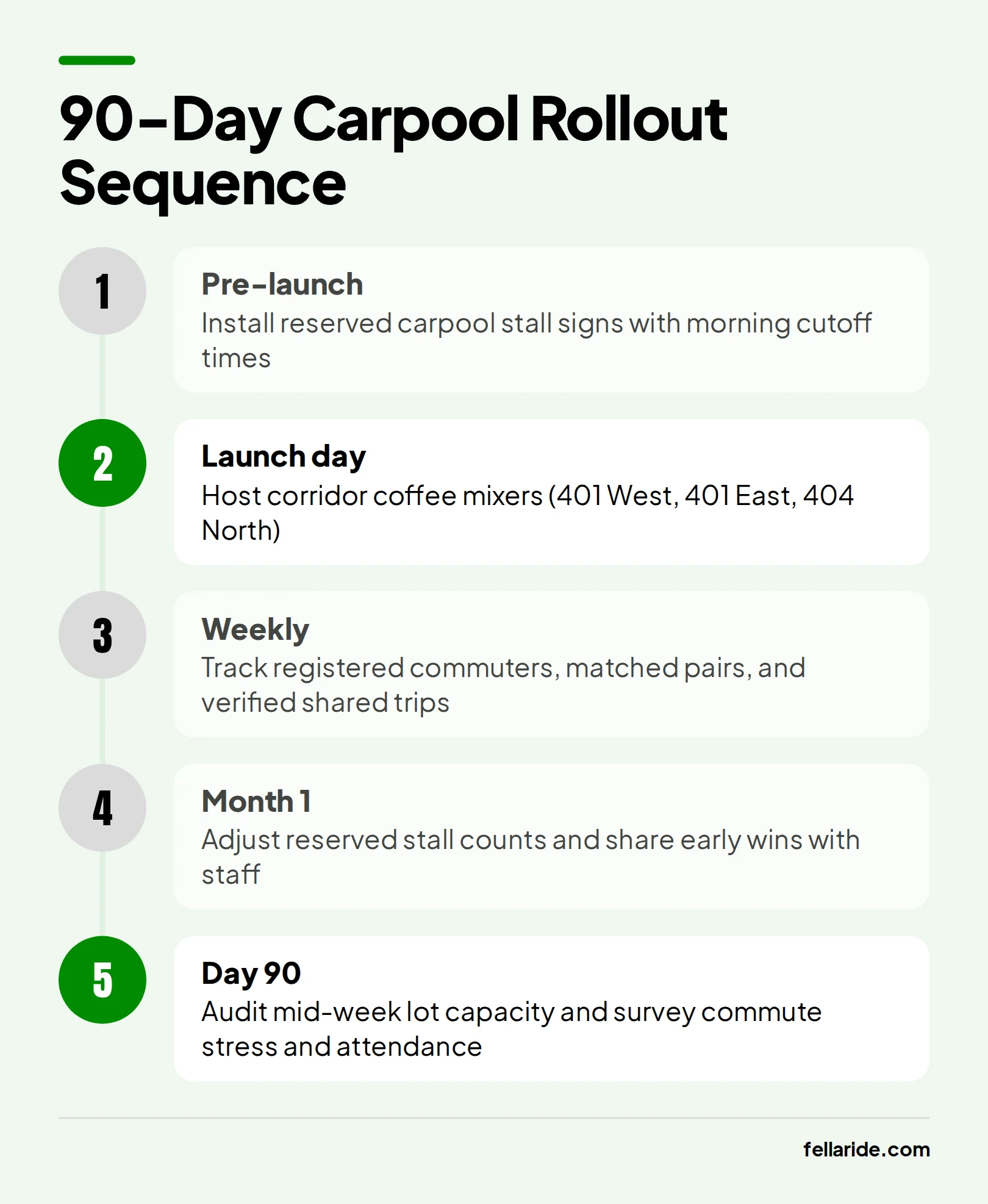
Treat your launch as an interactive workplace event rather than a single email memo. Host a short coffee-and-bagel mixer in the cafeteria where commuters grouped by highway corridor (such as 401 West, 401 East, or 404 North) can meet face to face before sharing a ride.
Ask department leaders to remind teams about the reserved parking stalls and the Guaranteed Ride Home guarantee when scheduling in-office anchor days. Once rides are underway, review your metrics monthly to adjust the number of reserved stalls and report progress.
Track both operational parking relief and environmental impact. Verified trip counts and one-way commute distances give sustainability teams accurate primary data instead of rough regional averages.
Share early wins with your staff after the first month. Letting teams know how many parking stalls opened up on Tuesdays and Wednesdays or how many kilometres were saved keeps momentum high and encourages hesitant solo drivers to try matching for a ride.